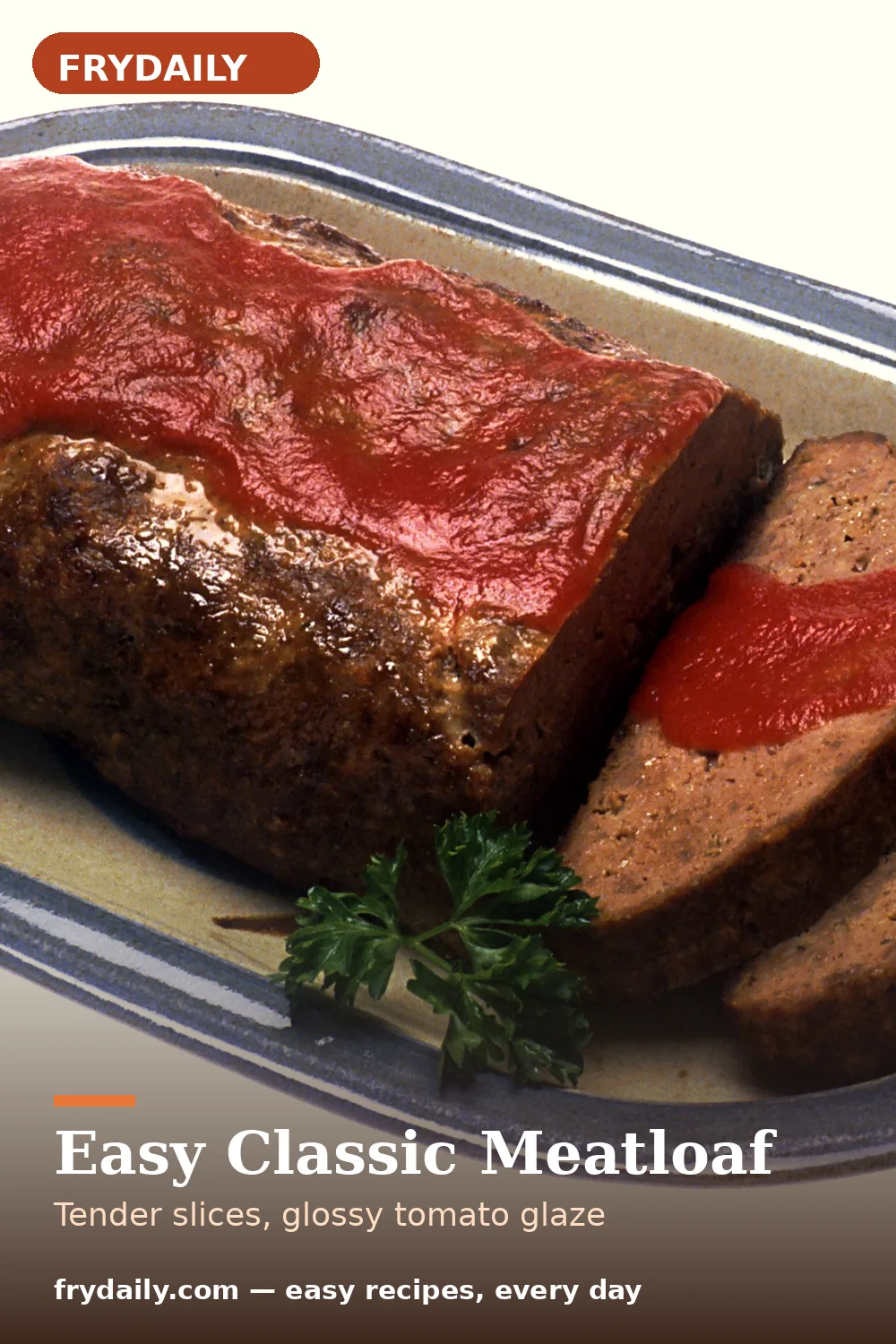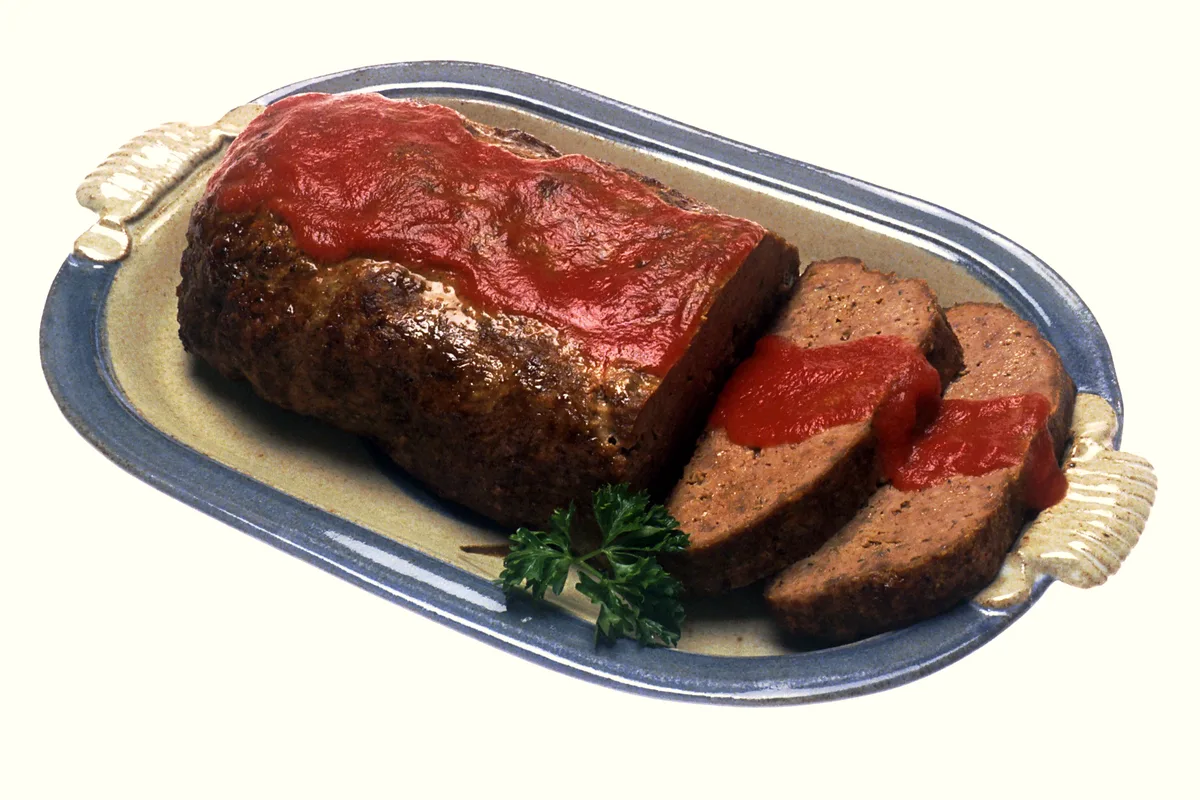
Meatloaf has survived every food fashion of the last seventy years because, done right, it is one of the great comfort dinners: a tender, well-seasoned loaf with a burnished crust and a sweet-sharp tomato glaze, sliced thick next to mashed potatoes. The photograph is the classic presentation — the whole loaf glazed deep red, two slices cut and sauced, parsley alongside. Nothing fancy, and nothing needs to be.
It sits in our Easy Dinners rotation next to Spaghetti and Meatballs and Ground Beef Tacos — the ground-beef shelf. The meatloaf and the meatballs share the same insurance policy against dryness: a panade, the simple paste of breadcrumbs and milk that keeps ground meat tender while it bakes. It is the step most rushed recipes skip, and it is most of the difference.
The loaf is shaped free-form on a sheet pan rather than packed into a loaf tin, and that choice is deliberate: the sides get to crust and caramelise instead of steaming in their own juices, and the glaze coats the top in a proper layer. The tin still works if you prefer it — the notes in the steps cover the small change in timing.
The panade keeps it tender
Ground beef baked on its own contracts as it cooks and squeezes out moisture, which is how meatloaf earns its dry, crumbly reputation. A panade — fresh breadcrumbs soaked in milk into a paste, then mixed through the meat — physically gets between the meat proteins and stops them knitting into a tight, tough network. The result slices cleanly but eats soft, almost like a giant meatball. Give the crumbs a full five minutes in the milk before mixing, and mix the loaf with your hands only until everything is just combined: overworking undoes the panade's good work in a minute.
Glaze twice, not once
A single layer of glaze applied at the start mostly slides off or dulls into the surface. The method here bakes the loaf bare for the first stretch so the surface sets and dries, then paints the glaze on in two coats — one to bake into a tacky layer, a second near the end to stay glossy. The photograph's deep-red shine is the two-coat result. The glaze itself is the classic trio: ketchup for body, brown sugar for the caramel edge, and a splash of vinegar so the sweetness stays interesting instead of flat.
Ingredients
- 2 lb ground beef (900 g), 80/20
- 3/4 cup plain breadcrumbs (75 g)
- 1/2 cup whole milk (120 ml)
- 1 medium yellow onion (about 150 g), finely grated or minced
- 2 garlic cloves (about 6 g), minced
- 1 large egg
- 2 tablespoons ketchup (30 g), for the loaf
- 1 tablespoon Worcestershire sauce (15 ml)
- 1 1/2 teaspoons fine salt (9 g)
- 1/2 teaspoon black pepper (1.5 g)
- 1 teaspoon dried parsley (1 g), or 1 tablespoon fresh (4 g)
- 3/4 cup ketchup (180 g), for the glaze
- 2 tablespoons light brown sugar (24 g)
- 1 tablespoon apple cider vinegar (15 ml)
- 1 tablespoon chopped fresh parsley (4 g), to serve
Amounts are for the yield below. US customary measures first, grams in brackets for scale users.
Step-by-step instructions
- Make the panade and the mix. Heat the oven to 350°F (177°C) and line a rimmed sheet pan with parchment. Stir the breadcrumbs and milk together in a large bowl and leave for 5 minutes to form a paste. Add the beef, onion, garlic, egg, 2 tablespoons ketchup, Worcestershire, salt, pepper and dried parsley. Mix with your hands until just combined — stop the moment the streaks disappear.
- Shape the loaf free-form. Tip the mixture onto the prepared pan and shape it with damp hands into a loaf about 9 by 5 inches (23 by 13 cm) and 2 inches (5 cm) thick, smoothing the surface. A free-form loaf crusts on all sides; press out any cracks, which widen as it bakes.
- Bake the first stretch. Bake for 35 minutes, until the surface has set and browned at the edges and the loaf feels firm when pressed. Meanwhile whisk the glaze ketchup, brown sugar and vinegar together in a small bowl.
- Glaze, twice. Spread half the glaze over the top and sides of the loaf and return it to the oven for 10 minutes. Spread the remaining glaze over the top and bake for 10 minutes more, until the glaze is glossy and darkened at the edges and the centre of the loaf reads 160°F (71°C).
- Rest, then slice thick. Rest the meatloaf for 10 minutes — slicing early spills the juices the panade worked to keep. Cut into slices about 3/4 inch (2 cm) thick, spoon any pan juices over them, and scatter the fresh parsley. Serve exactly as the photograph plates it: loaf on a platter, slices fanned alongside, glaze shining.
Nutrition estimate
| Nutrient | Per serving |
|---|---|
| Calories | 384 kcal |
| Protein | 28 g |
| Carbohydrates | 22 g |
| Fat | 20 g |
| Saturated fat | 8 g |
| Sodium | 820 mg |
| Fiber | 1 g |
| Sugar | 13 g |
Nutrition figures are estimates calculated from standard ingredient data for the yield stated. Your actual values will vary with brands, substitutions and portion sizes — treat them as a guide, not a guarantee.
Storage & reheating
Cooked meatloaf keeps, well wrapped, in the refrigerator for up to 4 days, and leftover slices are arguably better than the first serving — cold in a sandwich or reheated gently. Reheat slices in a covered skillet over low heat with a spoonful of water, or in a 325°F (163°C) oven for 12 to 15 minutes. The whole loaf or individual slices freeze for up to 3 months; thaw overnight in the fridge before reheating.
Easy Classic Meatloaf
Tender slices, glossy tomato glaze — the diner classic, done right.
Ingredients
Tick ingredients off as you prep, and tap a step below to mark it done as you cook. Scaling adjusts the listed amounts - seasoning to taste stays your call.
Instructions
- Make the panade and the mix. Heat the oven to 350°F (177°C) and line a rimmed sheet pan with parchment. Stir the breadcrumbs and milk together in a large bowl and leave for 5 minutes to form a paste. Add the beef, onion, garlic, egg, 2 tablespoons ketchup, Worcestershire, salt, pepper and dried parsley. Mix with your hands until just combined — stop the moment the streaks disappear.
- Shape the loaf free-form. Tip the mixture onto the prepared pan and shape it with damp hands into a loaf about 9 by 5 inches (23 by 13 cm) and 2 inches (5 cm) thick, smoothing the surface. A free-form loaf crusts on all sides; press out any cracks, which widen as it bakes.
- Bake the first stretch. Bake for 35 minutes, until the surface has set and browned at the edges and the loaf feels firm when pressed. Meanwhile whisk the glaze ketchup, brown sugar and vinegar together in a small bowl.
- Glaze, twice. Spread half the glaze over the top and sides of the loaf and return it to the oven for 10 minutes. Spread the remaining glaze over the top and bake for 10 minutes more, until the glaze is glossy and darkened at the edges and the centre of the loaf reads 160°F (71°C).
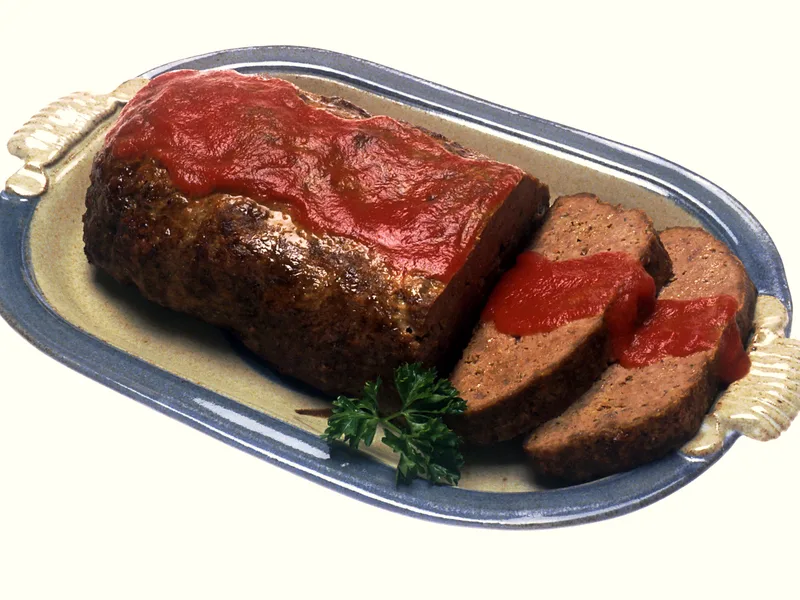
- Rest, then slice thick. Rest the meatloaf for 10 minutes — slicing early spills the juices the panade worked to keep. Cut into slices about 3/4 inch (2 cm) thick, spoon any pan juices over them, and scatter the fresh parsley. Serve exactly as the photograph plates it: loaf on a platter, slices fanned alongside, glaze shining.
Recipe by Ahsan ul Haq · FryDaily. Printing? This card is designed to print cleanly on its own.