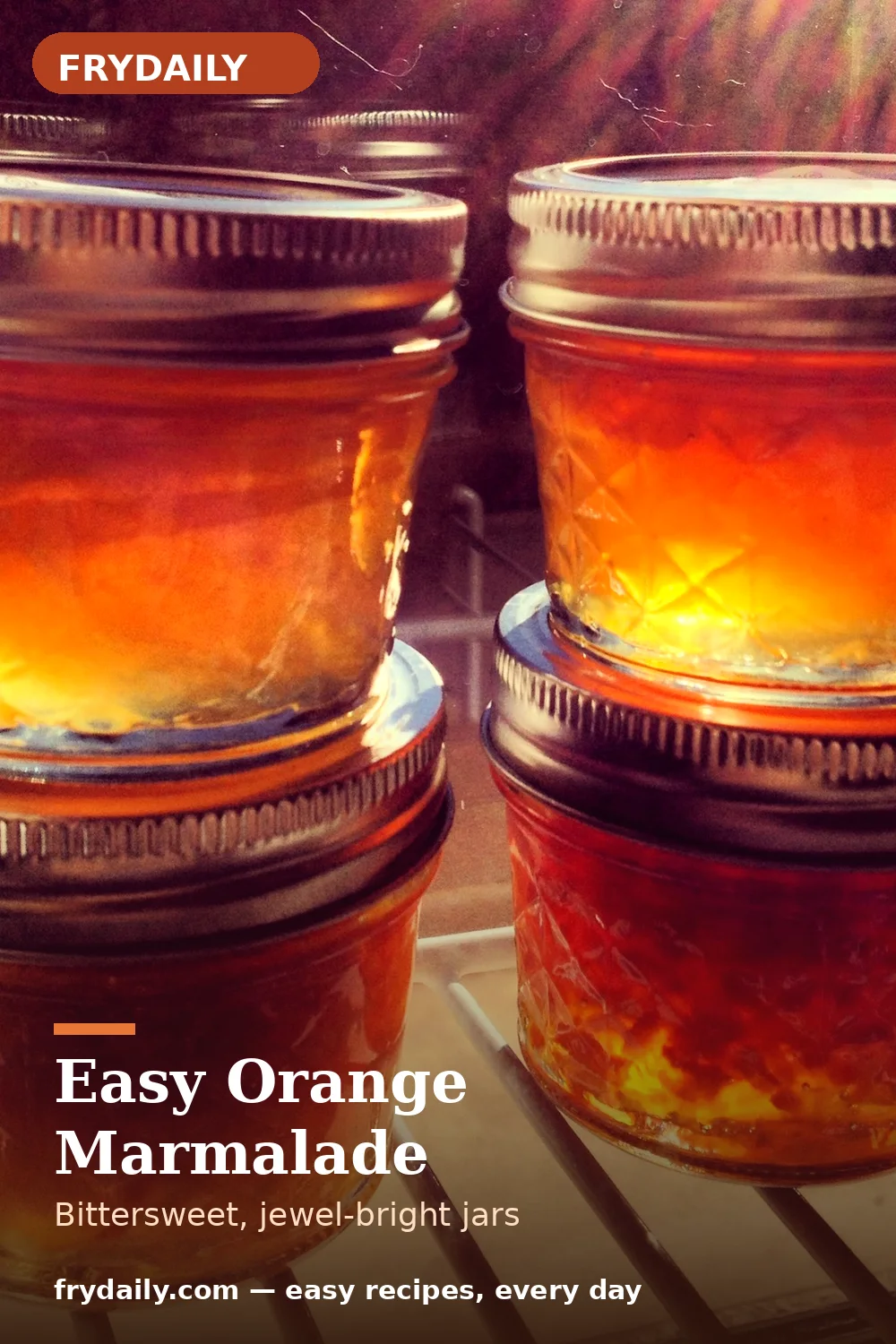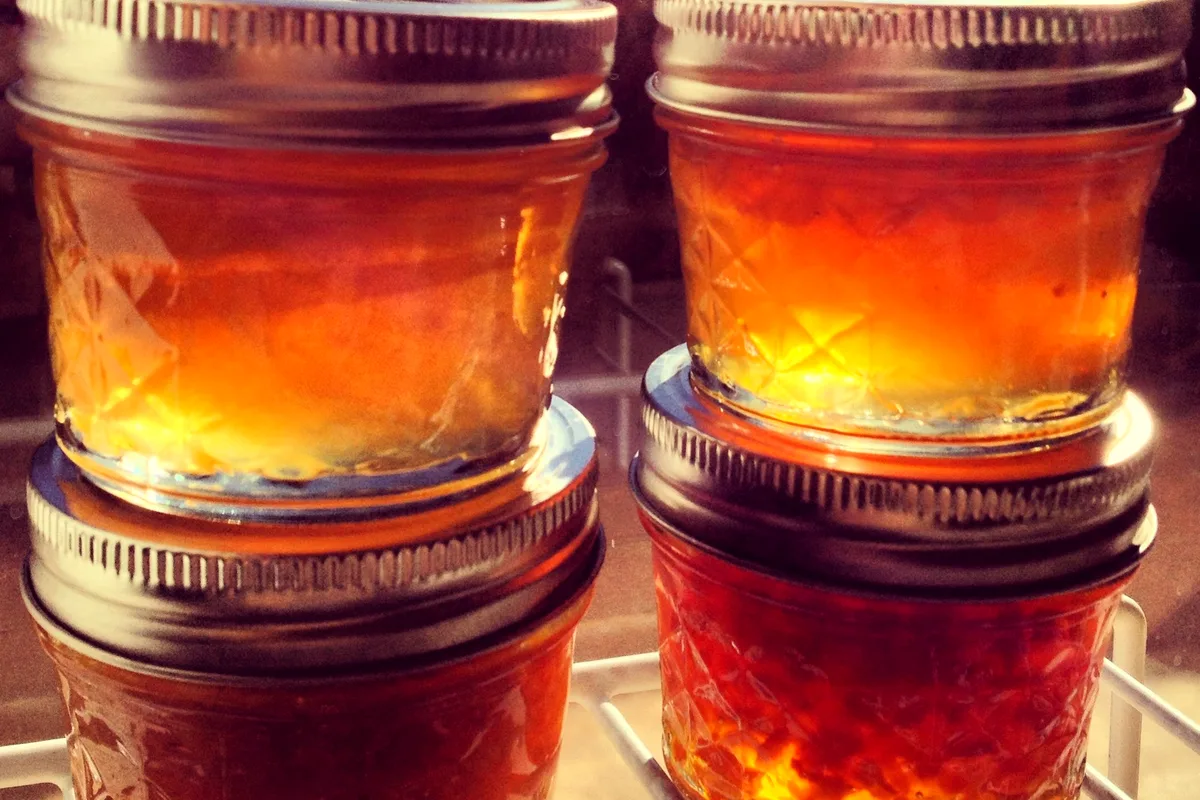
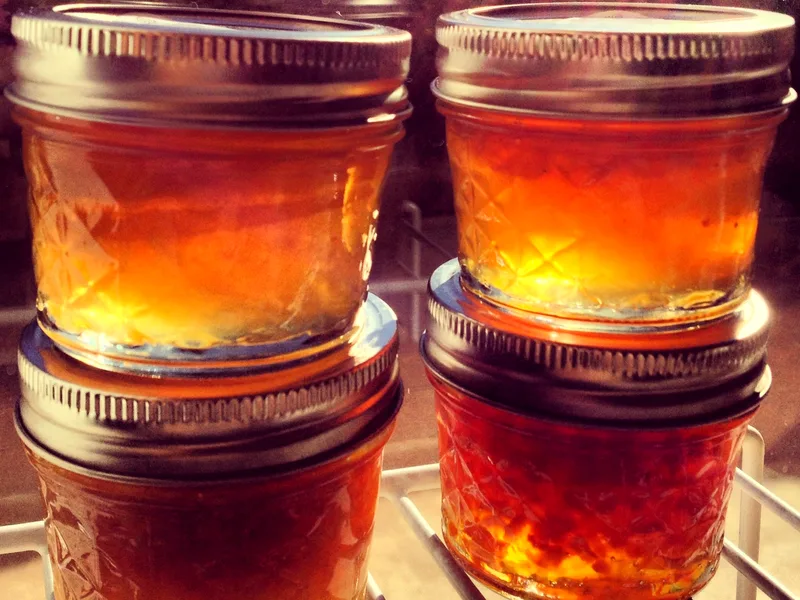
Marmalade is the preserve for people who find ordinary jam too sweet. Done properly it is bittersweet and bright, with tender ribbons of orange peel suspended in a clear amber jelly — and despite its reputation as a fiddly, all-day project, a small batch is genuinely simple: oranges, water, sugar, lemon, time, and a cold saucer to test the set. The finished jars glow on the shelf exactly like the ones in the photograph.
It belongs in our Canning & Preserving collection with our Peach Jam — the peach jam uses packaged pectin for its set, while this marmalade sets the old way, from the pectin in the orange pips and pith, simmered out into the cooking liquid. Both are processed in the water bath with tested times; always confirm the processing time for your altitude against current USDA guidance before you start.
Thin-skinned oranges make the best marmalade. Seville oranges are the classic choice in their short winter season and give the truest bitter edge; the rest of the year, regular navel oranges with a lemon alongside make a marmalade that is brighter and a little sweeter, and honestly excellent on toast.
The peel is the marmalade — treat it kindly
Everything distinctive about marmalade lives in the peel: the bitterness, the aroma, the shreds you see in the jar. Cut it fine — matchstick shreds about as wide as a toothpick — because thick peel never fully softens and eats like candied rope. The long simmer before the sugar goes in is not optional either: peel softened in plain water turns tender and translucent, while peel that meets sugar too early firms up and stays chewy no matter how long you cook it afterwards. Simmer first, sweeten second, and the texture takes care of itself.
Testing the set without a thermometer
Put two small saucers in the freezer before you start. When the marmalade has boiled for the given time, drop a teaspoon of it onto a cold saucer, return it to the freezer for 2 minutes, then push the surface gently with a fingertip. If it wrinkles and holds the ridge, it is set. If it slides liquidly, boil for 3 more minutes and test again. Marmalade is forgiving here — it firms further as it cools in the jar — so stop at the first clear wrinkle rather than boiling on towards toffee.
Ingredients
- 2 lb thin-skinned oranges (900 g), about 5 medium
- 1 large lemon (about 150 g)
- 4 cups water (960 ml)
- 4 cups granulated sugar (800 g)
Amounts are for the yield below. US customary measures first, grams in brackets for scale users.
Step-by-step instructions
- Prepare the fruit and peel. Scrub the oranges and lemon well under warm water and dry them. Halve the fruit and squeeze out the juice, keeping it aside; scoop the pips and membranes into a small muslin cloth or a square of cheesecloth and tie it into a bundle — this is your pectin source. Slice the peel, pith and all, into fine shreds about 1/8 inch (3 mm) wide.
- Simmer the peel until tender. Put the shredded peel, the reserved juice, the water and the muslin bundle into a large, heavy pot. Bring to a boil, then simmer gently for 35 to 40 minutes, until the peel is completely tender and translucent and the liquid has reduced by roughly a third. Squeeze the bundle hard against the side of the pot to extract its jelly, then discard it.
- Add the sugar. Take the pot off the heat and stir in the sugar until it has fully dissolved — undissolved sugar can crystallise in the finished jars. Return the pot to a low heat for a few minutes to be sure every grain has melted, skimming off any scum that rises, then turn the heat up.
- Boil to the setting point. Bring the marmalade to a fast, rolling boil and cook for 15 to 20 minutes, stirring now and then so the peel does not settle and catch. Begin testing on a chilled saucer from 15 minutes: you want the surface to wrinkle when pushed. The marmalade will darken slightly and feel syrupy and heavy on the spoon as it approaches the set.
- Rest, then fill the jars. Take the pot off the heat and rest the marmalade for 5 minutes — this pause lets the peel distribute evenly through the jelly instead of floating to the top of every jar. Meanwhile keep 5 hot, clean half-pint (240 ml) jars ready. Stir the marmalade once, then ladle it into the jars leaving 1/4 inch (0.6 cm) of headspace. Remove air bubbles, wipe the rims clean, and apply the lids and bands fingertip-tight.
- Process and cool. Process the jars in a boiling-water canner, covered by at least 1 inch (2.5 cm) of water, for 10 minutes at altitudes up to 1,000 ft (305 m), adjusting upward for higher altitudes following current USDA guidance. Lift the jars onto a towel and leave undisturbed for 12 to 24 hours. Check the seals, label with the date, and store in a cool, dark place. The marmalade's flavour mellows and deepens over the first two weeks in the jar.
Nutrition estimate
| Nutrient | Per serving |
|---|---|
| Calories | 48 kcal |
| Protein | 0 g |
| Carbohydrates | 12 g |
| Fat | 0 g |
| Saturated fat | 0 g |
| Sodium | 1 mg |
| Fiber | 0 g |
| Sugar | 12 g |
Nutrition figures are estimates calculated from standard ingredient data for the yield stated. Your actual values will vary with brands, substitutions and portion sizes — treat them as a guide, not a guarantee.
Storage & reheating
Sealed jars keep in a cool, dark place for up to 12 months. Once opened, refrigerate and use within about a month — marmalade's high sugar and acid make it a good keeper even open. Any jar that fails to seal should be refrigerated and used within 2 weeks. Nutrition is estimated per tablespoon. For home canning, always follow current USDA guidelines and tested processing times for your altitude.
Canning safety — read first
Home canning must follow tested processes exactly. The times on this page follow the structure of current USDA guidance for the stated jar size at 0-1,000 feet elevation; always confirm processing times and altitude adjustments in the USDA Complete Guide to Home Canning or the National Center for Home Food Preservation before you start. Never taste food from a jar with a failed seal, bulging lid or off odor — discard it.
Easy Orange Marmalade
Bittersweet, jewel-bright, tender peel in every spoonful — marmalade done simply.
Ingredients
Tick ingredients off as you prep, and tap a step below to mark it done as you cook. Scaling adjusts the listed amounts - seasoning to taste stays your call.
Instructions
- Prepare the fruit and peel. Scrub the oranges and lemon well under warm water and dry them. Halve the fruit and squeeze out the juice, keeping it aside; scoop the pips and membranes into a small muslin cloth or a square of cheesecloth and tie it into a bundle — this is your pectin source. Slice the peel, pith and all, into fine shreds about 1/8 inch (3 mm) wide.
- Simmer the peel until tender. Put the shredded peel, the reserved juice, the water and the muslin bundle into a large, heavy pot. Bring to a boil, then simmer gently for 35 to 40 minutes, until the peel is completely tender and translucent and the liquid has reduced by roughly a third. Squeeze the bundle hard against the side of the pot to extract its jelly, then discard it.
- Add the sugar. Take the pot off the heat and stir in the sugar until it has fully dissolved — undissolved sugar can crystallise in the finished jars. Return the pot to a low heat for a few minutes to be sure every grain has melted, skimming off any scum that rises, then turn the heat up.
- Boil to the setting point. Bring the marmalade to a fast, rolling boil and cook for 15 to 20 minutes, stirring now and then so the peel does not settle and catch. Begin testing on a chilled saucer from 15 minutes: you want the surface to wrinkle when pushed. The marmalade will darken slightly and feel syrupy and heavy on the spoon as it approaches the set.
- Rest, then fill the jars. Take the pot off the heat and rest the marmalade for 5 minutes — this pause lets the peel distribute evenly through the jelly instead of floating to the top of every jar. Meanwhile keep 5 hot, clean half-pint (240 ml) jars ready. Stir the marmalade once, then ladle it into the jars leaving 1/4 inch (0.6 cm) of headspace. Remove air bubbles, wipe the rims clean, and apply the lids and bands fingertip-tight.
- Process and cool. Process the jars in a boiling-water canner, covered by at least 1 inch (2.5 cm) of water, for 10 minutes at altitudes up to 1,000 ft (305 m), adjusting upward for higher altitudes following current USDA guidance. Lift the jars onto a towel and leave undisturbed for 12 to 24 hours. Check the seals, label with the date, and store in a cool, dark place. The marmalade's flavour mellows and deepens over the first two weeks in the jar.
Recipe by Ahsan ul Haq · FryDaily. Printing? This card is designed to print cleanly on its own.