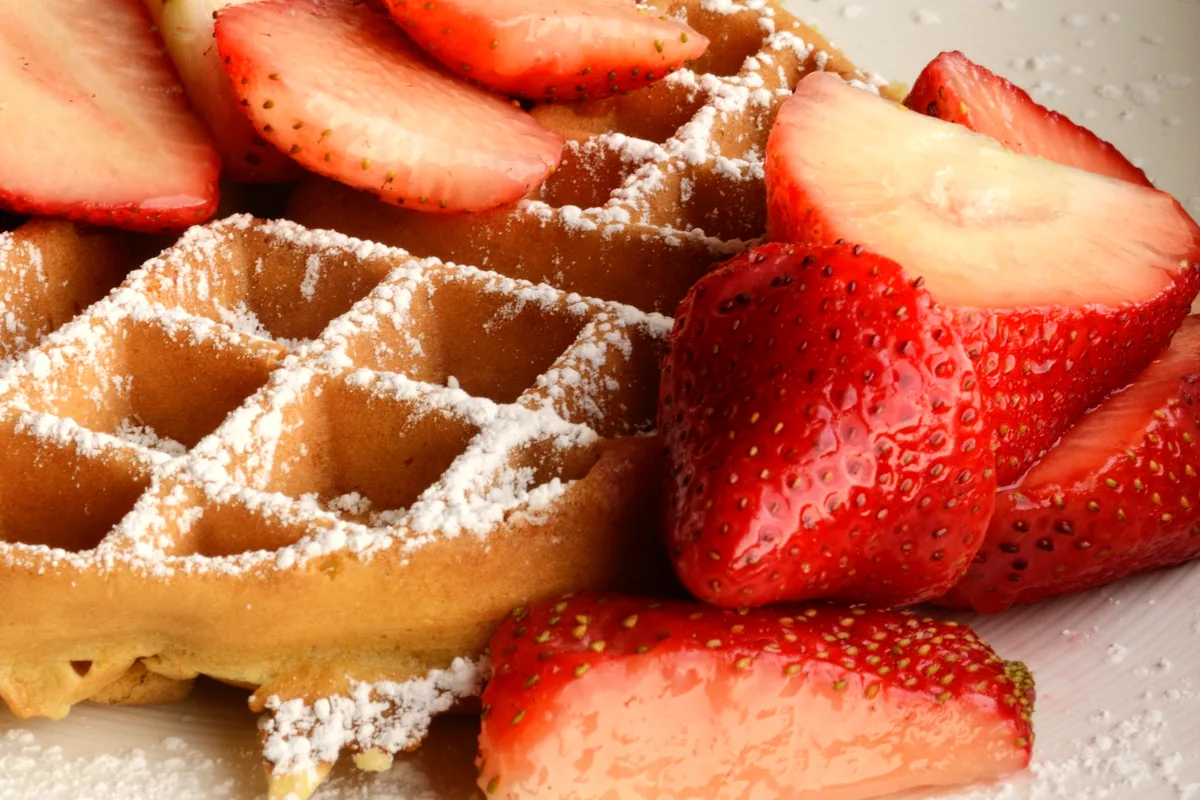
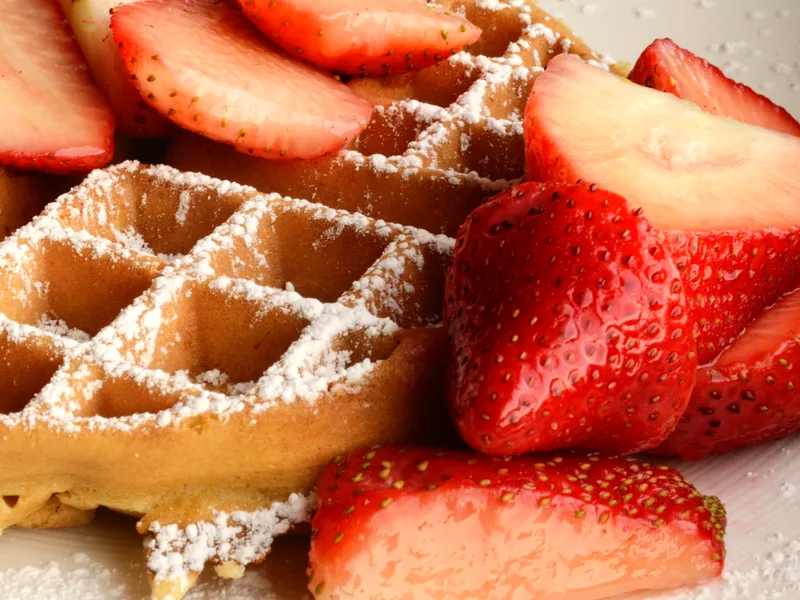
A Belgian waffle is judged by its pockets: deep squares that hold pools of syrup and berries, walls that stay crisp while the middle stays soft. The photograph is the close-up every waffle promises — a golden grid dusted with powdered sugar, sliced strawberries piled into the pockets. Getting there is mostly batter discipline: the right thickness, a fully hot iron, and the patience to leave the lid down until the steam slows.
These sit in our Breakfast collection with Buttermilk Pancakes and Blueberry Muffins — the weekend shelf. The batter shares the pancakes' buttermilk base, but a Belgian waffle batter is richer and slightly thicker, with more fat for the crisp edges and a spoonful of cornstarch, which is the quiet trick behind a crust that stays crisp on the plate instead of softening in its own steam.
The recipe makes six deep-pocket waffles in a standard Belgian iron. Batter waits badly — the leavening starts working the moment it is mixed — so the method heats the iron first and mixes last. Everything else, the berries and sugar included, should be on the table before the first waffle lands.
Cornstarch is the crispness
Flour alone makes a waffle that crisps in the iron and then softens within minutes on the plate, because its starches drink the steam the hot waffle keeps releasing. Replacing a quarter of the flour with cornstarch changes the set: the crust dries harder, browns evenly, and holds its crunch long enough to reach the table and be eaten at human speed. It is the same reason good fried coatings use it. Do not skip it and do not double it — doubled, the waffles turn brittle and pale; at this ratio they are crisp outside and properly tender in the middle.
Steam is your timer
Every waffle iron lies a little — lights, beeps and dials included. The honest signal is steam. A cooking waffle pours steam from the sides of the iron; when that steam slows to a wisp, the interior has set and the crust has dried, and the waffle is ready. Opening the lid early to check tears a half-set waffle and costs you the crisp top grid, so commit: batter in, lid down, hands off until the steam says so. A waffle that needs prying was not done; a done waffle releases almost by itself.
Ingredients
- 1 3/4 cups all-purpose flour (210 g)
- 1/4 cup cornstarch (32 g)
- 2 tablespoons granulated sugar (24 g)
- 1 tablespoon baking powder (12 g)
- 1/2 teaspoon fine salt (3 g)
- 1 1/2 cups buttermilk (360 ml)
- 2 large eggs
- 1/2 cup unsalted butter (113 g), melted and slightly cooled
- 2 teaspoons vanilla extract (10 ml)
- Oil spray or melted butter, for the iron
- 2 cups sliced fresh strawberries (about 300 g), to serve
- 2 tablespoons powdered sugar (14 g), to serve
- Maple syrup, to serve
Amounts are for the yield below. US customary measures first, grams in brackets for scale users.
Step-by-step instructions
- Heat the iron, then mix the dry ingredients. Set your Belgian waffle iron to preheat at medium-high — it must be fully hot before batter exists. Whisk the flour, cornstarch, sugar, baking powder and salt in a large bowl.
- Whisk the wet ingredients and combine. Whisk the buttermilk, eggs, melted butter and vanilla in a second bowl until uniform. Pour the wet into the dry and stir with a spatula until just combined — a few small lumps are correct and expected. Overmixing develops gluten and turns waffles chewy; stop early. Rest the batter for 5 minutes while the iron finishes heating.
- Cook the first waffle. Brush or spray the grids lightly with oil or butter. Ladle in enough batter to just cover the peaks of the bottom grid — about 3/4 cup (180 ml) for a standard round iron — close the lid and cook without opening it for 4 to 6 minutes, until the steam slows to a wisp and the waffle is deep golden.
- Crisp-keep the finished waffles. Lift the waffle out with a fork onto a wire rack — never a plate, where its own steam softens the underside — and keep finished waffles on the rack in a 200°F (95°C) oven while you cook the rest. Re-grease the iron only if a waffle hesitates to release.
- Serve with strawberries and sugar. Take the waffles straight to the table. Pile the sliced strawberries into the pockets, dust generously with powdered sugar the way the photograph shows, and pass the maple syrup separately so the crust stays crisp until the last bite.
Nutrition estimate
| Nutrient | Per serving |
|---|---|
| Calories | 348 kcal |
| Protein | 7 g |
| Carbohydrates | 42 g |
| Fat | 17 g |
| Saturated fat | 10 g |
| Sodium | 420 mg |
| Fiber | 2 g |
| Sugar | 11 g |
Nutrition figures are estimates calculated from standard ingredient data for the yield stated. Your actual values will vary with brands, substitutions and portion sizes — treat them as a guide, not a guarantee.
Storage & reheating
Waffles are best in the first ten minutes, but leftovers keep well: cool completely on a rack, then refrigerate in an airtight container for up to 3 days or freeze, separated with parchment, for up to 2 months. Reheat straight from the fridge or freezer in a toaster or a 350°F (177°C) oven for 5 to 8 minutes until crisp again — the microwave returns them soft and steamed, which undoes the entire point.
Easy Belgian Waffles
Deep pockets, crisp edges — strawberries and a dusting of sugar.
Ingredients
Tick ingredients off as you prep, and tap a step below to mark it done as you cook. Scaling adjusts the listed amounts - seasoning to taste stays your call.
Instructions
- Heat the iron, then mix the dry ingredients. Set your Belgian waffle iron to preheat at medium-high — it must be fully hot before batter exists. Whisk the flour, cornstarch, sugar, baking powder and salt in a large bowl.
- Whisk the wet ingredients and combine. Whisk the buttermilk, eggs, melted butter and vanilla in a second bowl until uniform. Pour the wet into the dry and stir with a spatula until just combined — a few small lumps are correct and expected. Overmixing develops gluten and turns waffles chewy; stop early. Rest the batter for 5 minutes while the iron finishes heating.
- Cook the first waffle. Brush or spray the grids lightly with oil or butter. Ladle in enough batter to just cover the peaks of the bottom grid — about 3/4 cup (180 ml) for a standard round iron — close the lid and cook without opening it for 4 to 6 minutes, until the steam slows to a wisp and the waffle is deep golden.
- Crisp-keep the finished waffles. Lift the waffle out with a fork onto a wire rack — never a plate, where its own steam softens the underside — and keep finished waffles on the rack in a 200°F (95°C) oven while you cook the rest. Re-grease the iron only if a waffle hesitates to release.
- Serve with strawberries and sugar. Take the waffles straight to the table. Pile the sliced strawberries into the pockets, dust generously with powdered sugar the way the photograph shows, and pass the maple syrup separately so the crust stays crisp until the last bite.
Recipe by Ahsan ul Haq · FryDaily. Printing? This card is designed to print cleanly on its own.