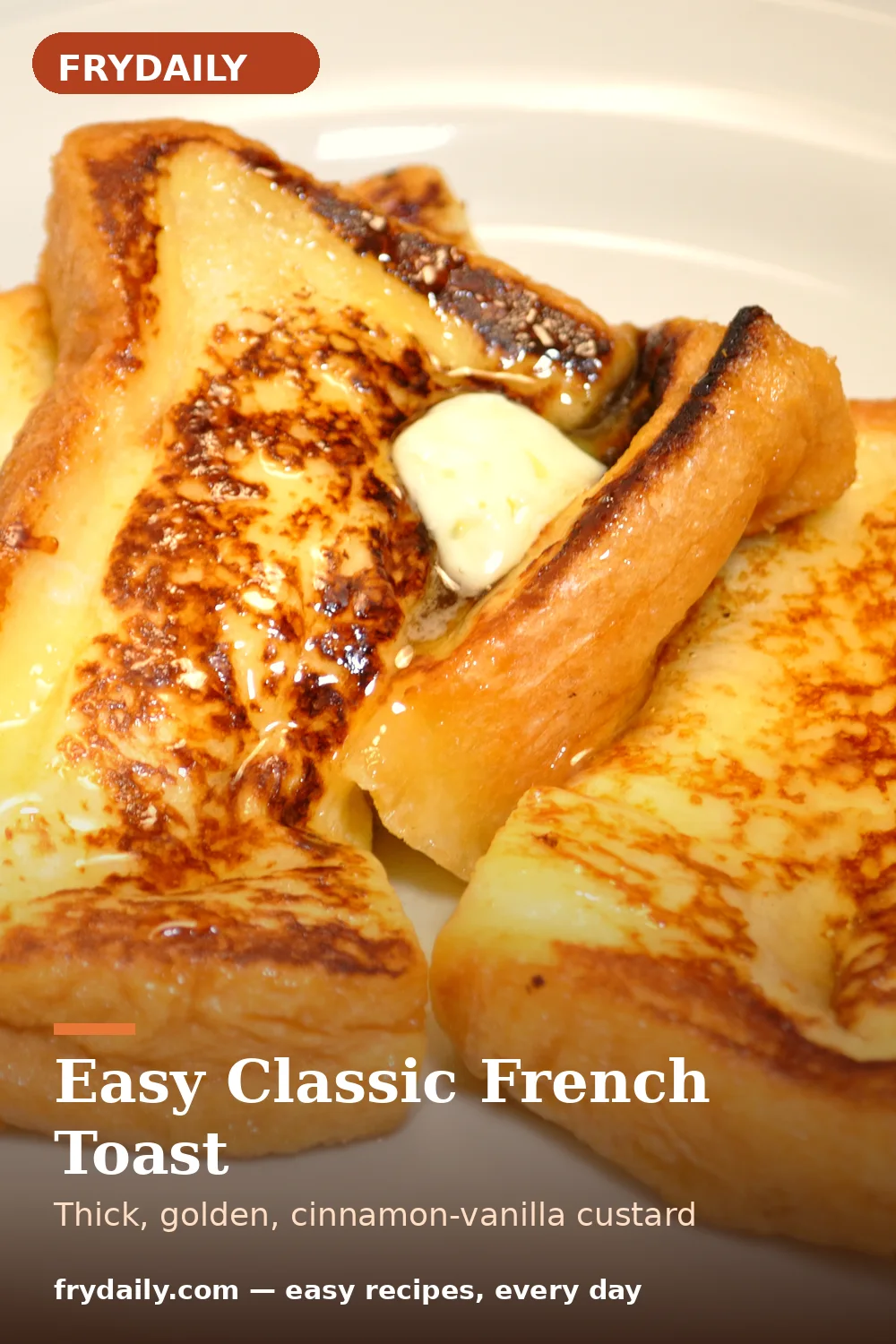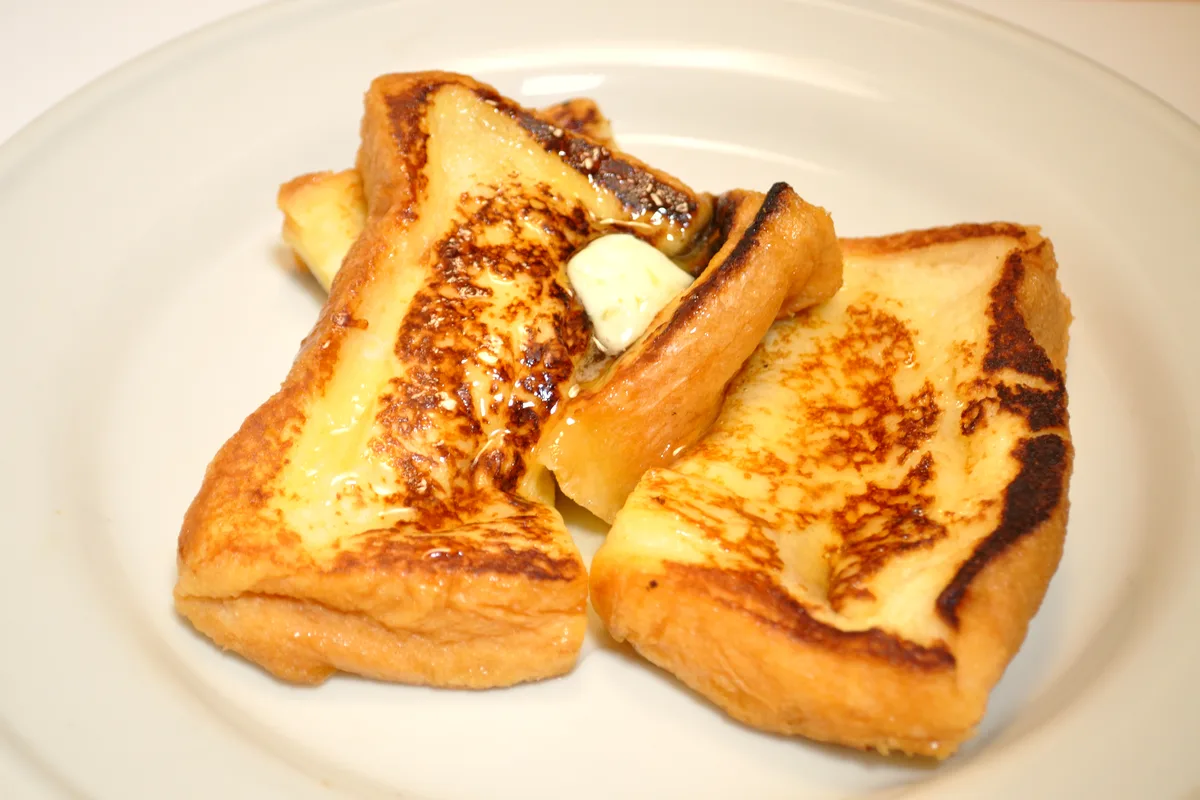
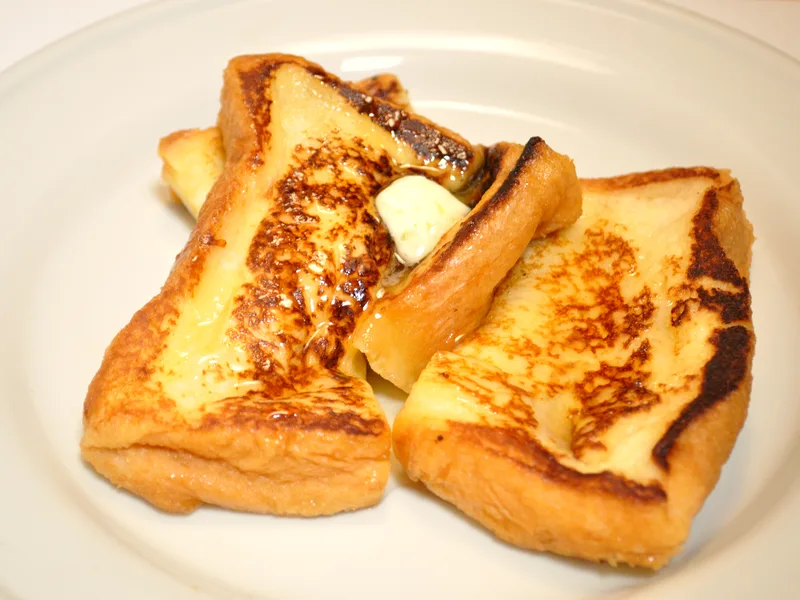
Classic French toast lives or dies on contrast: deep golden, almost crisp edges and browned custard spots on the outside — exactly what the slices on the plate in the photograph show — wrapped around a soft, custardy middle that still tastes of vanilla and cinnamon. It is a 25-minute recipe with five real ingredients, and the only way to get it wrong is to rush the two small steps this version refuses to skip.
It joins our Breakfast collection alongside Buttermilk Pancakes in the weekend rotation, and it is the fresh, griddled counterpart to Overnight Blueberry French Toast Bake — same flavours, no overnight wait. Where the bake feeds a crowd from the oven, these slices are cooked to order, two at a time, and eaten standing up by the cook as often as they reach the table.
The two steps that matter: use thick, slightly dry bread, and give each slice a short, timed soak — about twenty seconds a side — rather than a dunk or a long bath. Dry bread drinks the custard into its centre instead of letting it pool on the surface, and a measured soak keeps the slice intact, custardy rather than soggy, and able to brown properly in the pan. A spoonful of flour whisked into the custard is the quiet third trick: it helps the surface set into that lacy, golden crust.
Bread choice is the recipe
Brioche and challah are the classic choices because their enriched crumb soaks up custard and still fries into a delicate crust; thick-cut Texas toast and sturdy white sandwich bread are close behind. Whatever you choose, slice it thick — 3/4 to 1 inch (about 2 to 2.5 cm) — and let it sit out for an hour, or dry it in a low oven for 10 minutes, if it is fresh and soft. Thin, fresh bread is the single most common cause of soggy French toast: it cannot hold the custard, tears in the pan and steams instead of browning.
The custard ratio that never fails
For every egg, about a quarter cup of milk gives a custard that sets softly without tasting eggy; go much beyond that and the bread drinks too much liquid and slumps. Whole milk is the baseline, half-and-half makes it richer, and a splash of cream turns it into a special-occasion version. Whisk the flour, sugar and cinnamon into the eggs before the milk goes in, so nothing floats in dry pockets, and strain the custard if you see chalazae strands — two minutes of care that makes every slice evenly flavoured from edge to edge.
Ingredients
- 8 thick slices brioche or challah (about 400 g), preferably day-old
- 3 large eggs (about 150 g)
- 3/4 cup whole milk (180 ml)
- 1 tablespoon all-purpose flour (8 g)
- 1 tablespoon granulated sugar (12 g)
- 1 teaspoon ground cinnamon (2.6 g)
- 2 teaspoons vanilla extract (10 ml)
- 1/4 teaspoon fine salt (1.5 g)
- 2 tablespoons unsalted butter (28 g), for the pan
- Maple syrup and extra butter, to serve
Amounts are for the yield below. US customary measures first, grams in brackets for scale users.
Step-by-step instructions
- Whisk the custard. Whisk the eggs, flour, sugar, cinnamon and salt in a shallow dish — a pie plate is perfect — until no dry pockets remain, then whisk in the milk and vanilla until completely smooth. The flour needs the eggs first: whisked into liquid alone it clumps and never fully disappears. Set the dish beside the stove with the bread stacked next to it, because once the pan is hot this moves quickly and there is no good moment to go looking for the vanilla.
- Soak, timed. Heat a large skillet or griddle over medium heat and melt about half the butter until it foams. Working with two slices at a time, lay the bread in the custard for 20 seconds, flip it, and give it 20 seconds more. The slice should feel heavy and saturated but hold together when lifted — if it sags and threatens to tear, your bread is too fresh or the soak too long. Let the excess drip back into the dish for a few seconds; a flooded pan steams the surface pale.
- Griddle to deep golden. Lay the soaked slices in the foaming butter and cook for 2 to 3 minutes per side, until each face is deep golden with darker browned spots and the edges are set and slightly crisp, exactly the finish in the photograph. Adjust the heat as you go — the sugar in the custard browns fast, and the second batch always cooks quicker than the first. Add the remaining butter for the next batch and wipe the pan if the butter solids are darkening too far.
- Serve immediately, keep the rest warm. Serve the finished slices straight from the pan with butter and warm maple syrup — warm syrup matters more than people think, because cold syrup chills the toast on contact. Hold later batches on a rack in a 200°F (95°C) oven for up to 20 minutes; a rack, not a plate, so the undersides stay crisp. A dusting of powdered sugar at the table is decoration, not a requirement — the toast underneath is the point.
Nutrition estimate
| Nutrient | Per serving |
|---|---|
| Calories | 392 kcal |
| Protein | 11 g |
| Carbohydrates | 48 g |
| Fat | 17 g |
| Saturated fat | 8 g |
| Sodium | 380 mg |
| Fiber | 2 g |
| Sugar | 14 g |
Nutrition figures are estimates calculated from standard ingredient data for the yield stated. Your actual values will vary with brands, substitutions and portion sizes — treat them as a guide, not a guarantee.
Storage & reheating
French toast is best straight from the pan, but leftovers keep in the refrigerator for up to 3 days and reheat well in a toaster or a 350°F (177°C) oven for 5 to 6 minutes — better, honestly, than fresh pancakes reheat. It freezes very well: cool the slices, freeze them flat on a tray, then bag for up to 2 months and toast from frozen. Do not store soaked uncooked bread; the custard keeps separately in the fridge for a day, but bread should only meet it at cooking time. Nutrition values are estimates per serving without syrup.
Easy Classic French Toast
Thick, golden, cinnamon-scented — the weekend French toast that always works.
Ingredients
Tick ingredients off as you prep, and tap a step below to mark it done as you cook. Scaling adjusts the listed amounts - seasoning to taste stays your call.
Instructions
- Whisk the custard. Whisk the eggs, flour, sugar, cinnamon and salt in a shallow dish — a pie plate is perfect — until no dry pockets remain, then whisk in the milk and vanilla until completely smooth. The flour needs the eggs first: whisked into liquid alone it clumps and never fully disappears. Set the dish beside the stove with the bread stacked next to it, because once the pan is hot this moves quickly and there is no good moment to go looking for the vanilla.
- Soak, timed. Heat a large skillet or griddle over medium heat and melt about half the butter until it foams. Working with two slices at a time, lay the bread in the custard for 20 seconds, flip it, and give it 20 seconds more. The slice should feel heavy and saturated but hold together when lifted — if it sags and threatens to tear, your bread is too fresh or the soak too long. Let the excess drip back into the dish for a few seconds; a flooded pan steams the surface pale.
- Griddle to deep golden. Lay the soaked slices in the foaming butter and cook for 2 to 3 minutes per side, until each face is deep golden with darker browned spots and the edges are set and slightly crisp, exactly the finish in the photograph. Adjust the heat as you go — the sugar in the custard browns fast, and the second batch always cooks quicker than the first. Add the remaining butter for the next batch and wipe the pan if the butter solids are darkening too far.
- Serve immediately, keep the rest warm. Serve the finished slices straight from the pan with butter and warm maple syrup — warm syrup matters more than people think, because cold syrup chills the toast on contact. Hold later batches on a rack in a 200°F (95°C) oven for up to 20 minutes; a rack, not a plate, so the undersides stay crisp. A dusting of powdered sugar at the table is decoration, not a requirement — the toast underneath is the point.
Recipe by Ahsan ul Haq · FryDaily. Printing? This card is designed to print cleanly on its own.