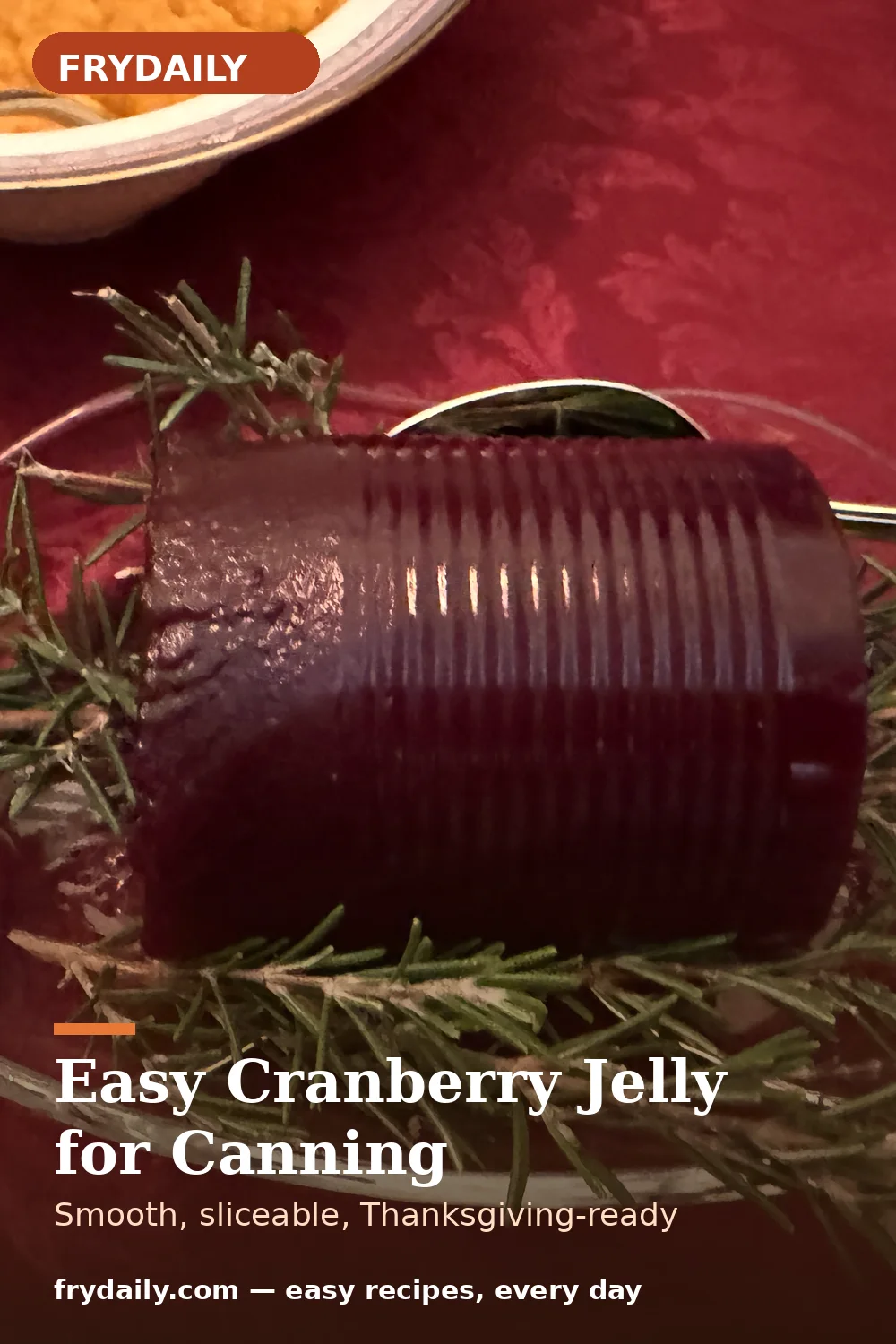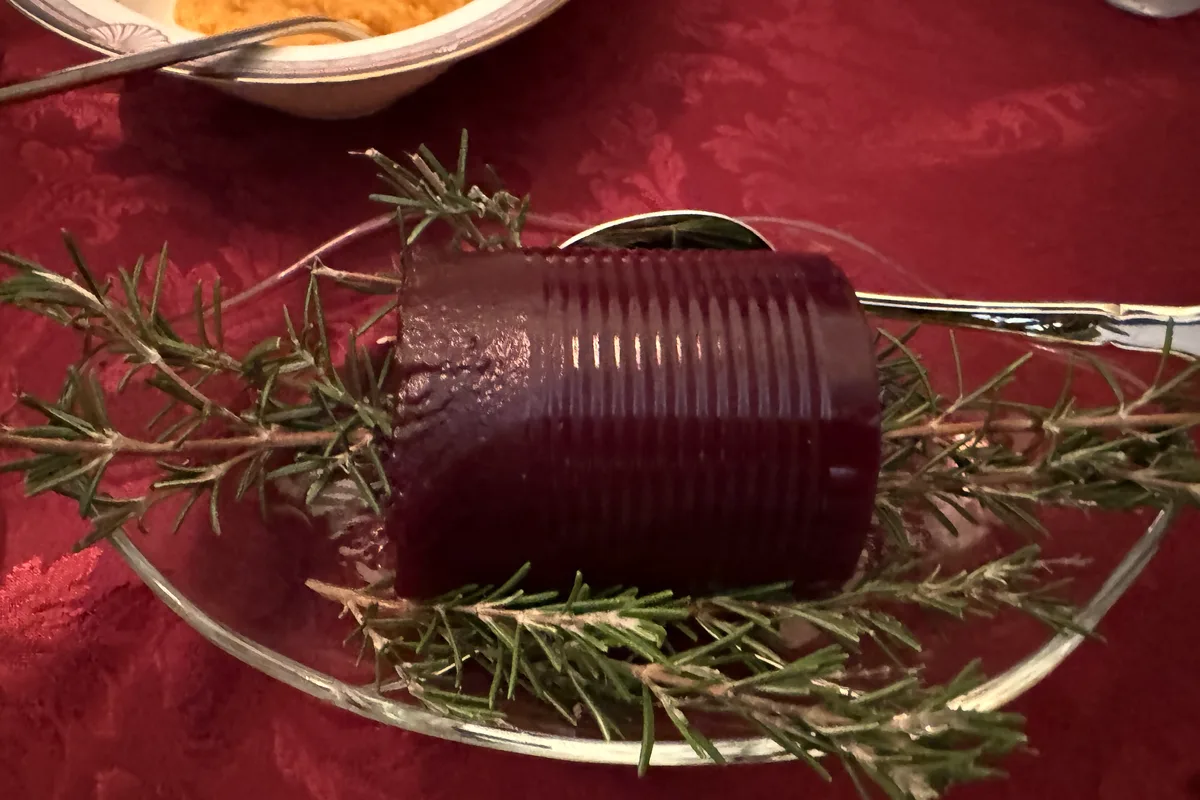
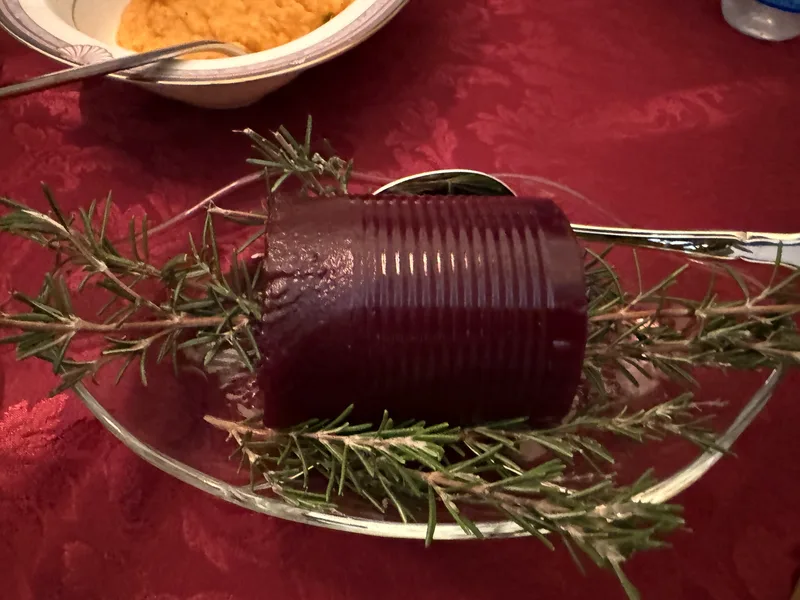
There are two kinds of cranberry people at Thanksgiving, and this jelly is for the ones who want the smooth, sliceable log — the kind that slides out of its mould in one glossy cylinder, holds its ridges, and cuts into neat ruby rounds. That is exactly the plate in the photograph: a deep-red jelly log unmoulded onto a glass plate with fresh rosemary sprigs tucked alongside, ready to slice. No berries bobbing in it, no seeds, nothing to chew through — just clean, tart-sweet cranberry flavour that sets firm enough to slice and soft enough to melt on the tongue.
The difference between this and our Whole Berry Cranberry Sauce is the strain. Here the cooked berries are poured through a jelly bag or cheesecloth and left to drip, so only clear juice goes back into the pot. It takes patience — a good hour of dripping — but the payoff is that glassy, jewel-like set. And unlike our Spiced Cranberry Chutney, there are no warm spices competing for attention; this is pure cranberry, sweetened just enough to balance the tartness.
It sits in our Canning & Preserving collection, and it is one of the most forgiving preserves a beginner can make: cranberries are naturally high in pectin, so the jelly sets reliably without added pectin, and a batch of four half-pint jars fits in an ordinary stockpot for water-bath processing. Make it now, while fresh cranberries are in the shops, and the jars will be waiting — sealed, labelled and handsome — when the turkey goes in the oven.
Do not press the bag — clarity is the whole point
The single most important habit in jelly-making is leaving the jelly bag alone once the berries go in. Pressing or squeezing it forces cloudy pulp through the cloth, and the finished jelly turns hazy instead of jewel-clear. Set the bag over a bowl, walk away, and let gravity do the work for a good hour, or overnight in the fridge if you are making this the day before jarring. You will get slightly less juice than a squeezed batch, but what you get is beautifully clear — and clarity is what makes this jelly look like the photograph.
The gel point is a temperature, not a guess
Cranberries set because of their own pectin, but only when the juice and sugar reach the gel point — 220°F (104°C) at sea level, or 8°F above the boiling point of water where you live. A thermometer takes all the guesswork out: clip it to the pot, watch for the rolling boil that will not stir down, and stop the moment it hits temperature. Overcooking past the gel point gives you a stiff, rubbery jelly; undercooking gives you syrup. If you cook without a thermometer, use the cold-plate test — a spoonful on a chilled saucer should wrinkle when you push it after a minute in the freezer.
Ingredients
- 2 lb fresh cranberries (900 g), rinsed and picked over
- 4 cups water (960 ml)
- 3 cups granulated sugar (600 g)
- 1 tablespoon lemon juice (15 ml)
- Fresh rosemary sprigs, to serve (optional)
Amounts are for the yield below. US customary measures first, grams in brackets for scale users.
Step-by-step instructions
- Simmer the cranberries. Put the cranberries and water in a large, heavy pot and bring to a boil over medium-high heat. Reduce to a simmer and cook for 15 to 20 minutes, stirring occasionally, until every berry has burst and the mixture looks like a thick, deep-red pulp. Do not add the sugar yet — sugar added too early toughens the skins and makes straining harder.
- Strain without pressing. Set a jelly bag or a colander lined with 3 layers of damp cheesecloth over a large bowl or measuring jug. Pour in the hot pulp and let it drip undisturbed for at least 1 hour, or overnight in the refrigerator. Do not press, squeeze or stir the bag — the clear juice that drips through is what makes a jewel-like jelly. You should have about 4 cups of juice.
- Measure and sweeten. Pour the juice back into a clean pot and stir in the sugar and lemon juice. The rule is simple and worth remembering: for every 1 cup of juice, use 3/4 cup of sugar. If your yield is a little under 4 cups, scale the sugar to match rather than topping up with water, which weakens the set.
- Boil to the gel point. Bring the sweetened juice to a full rolling boil over medium-high heat, stirring until the sugar dissolves. Boil hard, stirring frequently, for 8 to 12 minutes, skimming off any pale foam that rises. The jelly is ready at 220°F (104°C) on a thermometer, or when a spoonful on a chilled saucer wrinkles when pushed after a minute in the freezer.
- Jar and process. Ladle the hot jelly into hot, sterilized half-pint jars, leaving 1/4 inch of headspace, and wipe the rims clean. Fit lids and bands fingertip-tight, then process in a boiling water bath for 10 minutes (adjust for altitude: 15 minutes above 1,000 feet, 20 minutes above 6,000 feet). Turn off the heat, wait 5 minutes, then lift the jars out onto a towel.
- Cool, check and serve. Leave the jars undisturbed for 24 hours. The jelly sets as it cools, and sealed lids will be concave and will not flex when pressed. Label and store in a cool, dark place. To serve like the photograph, run a thin knife around the inside of an opened jar, turn the jelly out onto a plate, slice with a sharp wet knife, and tuck fresh rosemary sprigs alongside.
Nutrition estimate
| Nutrient | Per serving |
|---|---|
| Calories | 95 kcal |
| Protein | 0 g |
| Carbohydrates | 25 g |
| Fat | 0 g |
| Saturated fat | 0 g |
| Sodium | 1 mg |
| Fiber | 0 g |
| Sugar | 24 g |
Nutrition figures are estimates calculated from standard ingredient data for the yield stated. Your actual values will vary with brands, substitutions and portion sizes — treat them as a guide, not a guarantee.
Storage & reheating
Properly sealed jars keep in a cool, dark pantry for up to 12 months; once opened, refrigerate and use within 3 weeks. Unsealed jars are not shelf-stable — refrigerate those and use within 3 weeks, or reprocess within 24 hours with a new lid. You can also skip the water bath entirely and keep the whole batch as refrigerator jelly: pour into clean jars, cool, cap and refrigerate for up to 3 weeks. Nutrition figures are estimates per 2-tablespoon serving and vary with the exact juice yield and sugar measured; estimates vary.
Canning safety — read first
Home canning must follow tested processes exactly. The times on this page follow the structure of current USDA guidance for the stated jar size at 0-1,000 feet elevation; always confirm processing times and altitude adjustments in the USDA Complete Guide to Home Canning or the National Center for Home Food Preservation before you start. Never taste food from a jar with a failed seal, bulging lid or off odor — discard it.
Easy Cranberry Jelly for Canning
Smooth, sliceable, Thanksgiving-ready
Ingredients
Tick ingredients off as you prep, and tap a step below to mark it done as you cook. Scaling adjusts the listed amounts - seasoning to taste stays your call.
Instructions
- Simmer the cranberries. Put the cranberries and water in a large, heavy pot and bring to a boil over medium-high heat. Reduce to a simmer and cook for 15 to 20 minutes, stirring occasionally, until every berry has burst and the mixture looks like a thick, deep-red pulp. Do not add the sugar yet — sugar added too early toughens the skins and makes straining harder.
- Strain without pressing. Set a jelly bag or a colander lined with 3 layers of damp cheesecloth over a large bowl or measuring jug. Pour in the hot pulp and let it drip undisturbed for at least 1 hour, or overnight in the refrigerator. Do not press, squeeze or stir the bag — the clear juice that drips through is what makes a jewel-like jelly. You should have about 4 cups of juice.
- Measure and sweeten. Pour the juice back into a clean pot and stir in the sugar and lemon juice. The rule is simple and worth remembering: for every 1 cup of juice, use 3/4 cup of sugar. If your yield is a little under 4 cups, scale the sugar to match rather than topping up with water, which weakens the set.
- Boil to the gel point. Bring the sweetened juice to a full rolling boil over medium-high heat, stirring until the sugar dissolves. Boil hard, stirring frequently, for 8 to 12 minutes, skimming off any pale foam that rises. The jelly is ready at 220°F (104°C) on a thermometer, or when a spoonful on a chilled saucer wrinkles when pushed after a minute in the freezer.
- Jar and process. Ladle the hot jelly into hot, sterilized half-pint jars, leaving 1/4 inch of headspace, and wipe the rims clean. Fit lids and bands fingertip-tight, then process in a boiling water bath for 10 minutes (adjust for altitude: 15 minutes above 1,000 feet, 20 minutes above 6,000 feet). Turn off the heat, wait 5 minutes, then lift the jars out onto a towel.
- Cool, check and serve. Leave the jars undisturbed for 24 hours. The jelly sets as it cools, and sealed lids will be concave and will not flex when pressed. Label and store in a cool, dark place. To serve like the photograph, run a thin knife around the inside of an opened jar, turn the jelly out onto a plate, slice with a sharp wet knife, and tuck fresh rosemary sprigs alongside.
Recipe by Ahsan ul Haq · FryDaily. Printing? This card is designed to print cleanly on its own.