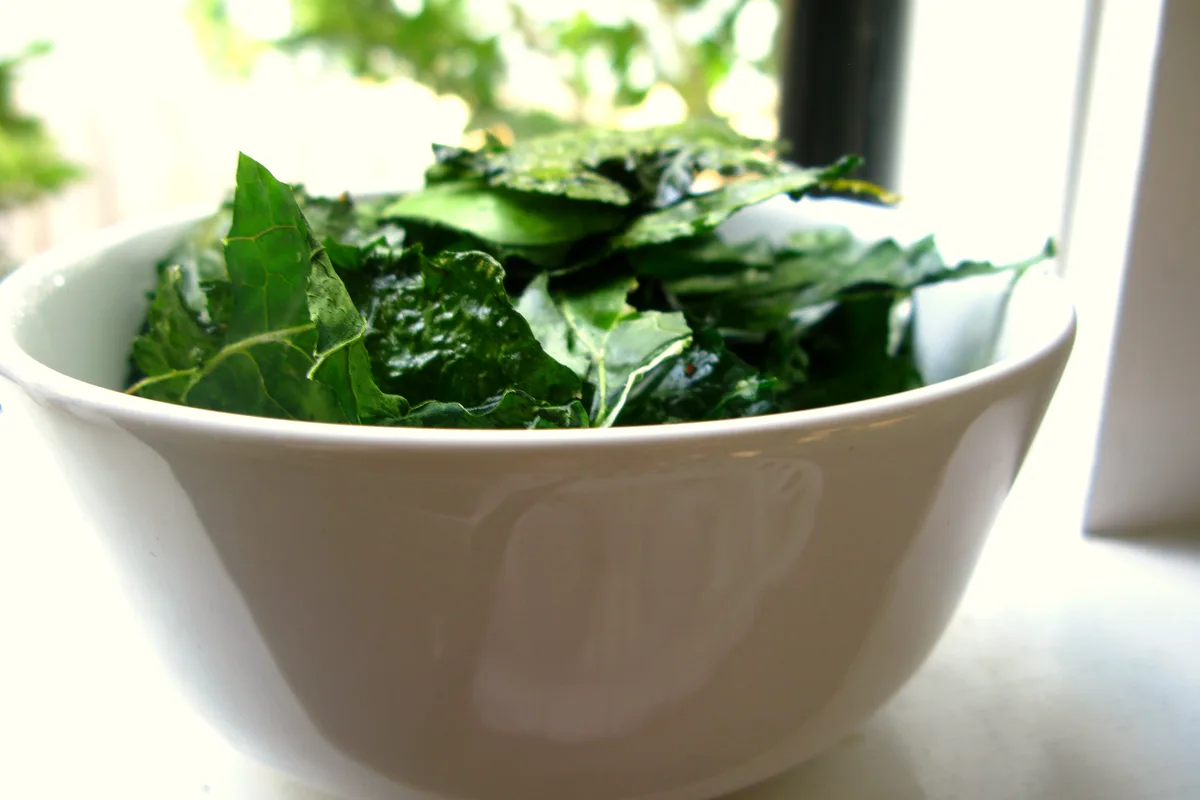
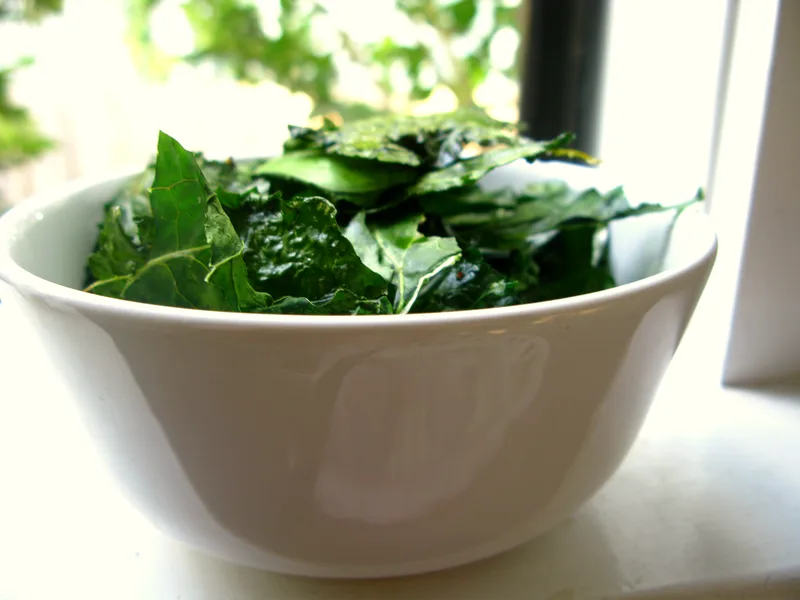
Kale chips are the rare healthy snack that people actually finish: a big bowl of dark-green, shatter-crisp leaves, salted while still warm, that disappears faster than anything else on the table. The photograph is the whole promise — a white bowl heaped with crackly chips by a bright window. They take about twenty-five minutes from washing the leaves to the first handful, and most of that time is the oven doing the work.
Two things decide whether kale chips turn out crisp or disappointing, and neither is a special ingredient. First, the leaves must be genuinely dry before they meet the oil; water is the enemy here, and damp kale steams instead of crisping. Second, the oven must stay low — 300°F (150°C) — and the leaves must sit in a single layer with room between them. Crowded kale traps steam and goes limp, while a hot oven burns the thin edges before the centres dry out. Get those two right and the recipe is almost impossible to ruin.
Serve them exactly as pictured, piled in a bowl for snacking, or set the bowl beside a dip the way you would any chip — they are excellent with our easy homemade hummus, and they sit happily in our Snacks & Sides collection next to our crispy roasted chickpeas, another crunchy snack that travels well to a party table. One large bunch makes about four snack-sized servings, though in practice it rarely survives long enough to be divided that neatly.
Dry leaves are the whole recipe
Kale holds water in every curl and fold, and that water has to be gone before baking. Wash the leaves, then spin them in a salad spinner if you have one — two or three spins, shaking the leaves loose between spins, gets them remarkably dry. Without a spinner, spread the leaves on clean kitchen towels, roll them up gently, and press. Then leave them spread on a dry towel for ten minutes while the oven heats. If a leaf still feels damp when you tear it, it is not ready — damp leaves bake into leathery strips, not chips.
Salt last, and season boldly
Salt goes on after baking, not before. Salt draws moisture out of raw leaves, which is the opposite of what you want while they are drying in the oven, so oil the leaves plain, bake them crisp, and season the moment they come out, while the surface oil is still tacky enough to hold the salt. The same rule covers every variation: garlic powder, smoked paprika, a spoonful of nutritional yeast for a cheesy note, or a dusting of finely grated parmesan all go on hot, straight from the oven. Taste one chip first, then season the rest of the batch — different salts land very differently, and flaky sea salt gives a cleaner crunch than fine table salt.
Ingredients
- 1 large bunch curly kale (225 g), stems removed
- 1 tablespoon olive oil (15 ml)
- 1/2 teaspoon fine sea salt (3 g), plus flaky sea salt to finish
- 1/4 teaspoon garlic powder (1 g), optional
- 1 tablespoon nutritional yeast (5 g), optional
- Hummus or dip, for serving
Amounts are for the yield below. US customary measures first, grams in brackets for scale users.
Step-by-step instructions
- Heat the oven and prepare the pans. Heat the oven to 300°F (150°C). Line two large rimmed baking sheets with parchment paper. The low temperature is deliberate: kale leaves are thin, and a hotter oven burns their edges before the centres have dried. Two pans matter just as much — one crowded pan makes limp chips.
- Wash, dry, and tear the kale. Pull the leaves from the thick centre stems and discard the stems. Wash the leaves well, then dry them thoroughly: spin in a salad spinner, then spread on clean kitchen towels and leave for 10 minutes. Tear the dry leaves into pieces roughly the size of a playing card — they shrink by about half in the oven, so pieces that look generous now will be chip-sized when they come out.
- Oil lightly, and only lightly. Put the torn leaves in a large bowl and drizzle over the olive oil. Toss with your hands for a full minute, rubbing the oil over the leaves until every piece has a faint sheen and none is dripping. Too much oil makes greasy chips that never quite crisp; too little leaves dry patches that scorch.
- Bake in a single layer. Spread the leaves on the prepared pans in a single layer, with a little space between pieces and none overlapping. Bake for 12 to 15 minutes, swapping the pans between racks halfway through, until the leaves are crisp all the way to the centre and the edges are just starting to darken. Check at 12 minutes: thin leaves finish fast, and the line between crisp and burnt is about sixty seconds wide.
- Season hot and serve at once. The moment the pans come out, sprinkle over the fine sea salt and the garlic powder or nutritional yeast if you are using them, then toss gently right on the pan. Finish with a pinch of flaky sea salt. Let the chips cool for 2 minutes — they crisp further as they cool — then pile into a bowl and serve, with hummus or dip if you like. They are at their best within a few hours of baking.
Nutrition estimate
| Nutrient | Per serving |
|---|---|
| Calories | 90 kcal |
| Protein | 3 g |
| Carbohydrates | 8 g |
| Fat | 5 g |
| Saturated fat | 1 g |
| Sodium | 300 mg |
| Fiber | 3 g |
| Sugar | 1 g |
Nutrition figures are estimates calculated from standard ingredient data for the yield stated. Your actual values will vary with brands, substitutions and portion sizes — treat them as a guide, not a guarantee.
Storage & reheating
Store completely cooled chips in an airtight container at room temperature for up to 2 days, with a small piece of paper towel in the container to absorb any humidity. They lose their snap quickly in damp air, so do not store them in the refrigerator and do not seal them while still warm — trapped steam turns them soft overnight. If a batch does go slightly soft, 5 minutes back in a 300°F (150°C) oven restores most of the crunch. Do not freeze kale chips; thawing makes them soggy. Nutrition figures are estimates from standard ingredient data and vary with brands and seasonings; estimates vary.
Easy Crispy Kale Chips
Shatter-crisp, sea-salted, 25 minutes.
Ingredients
Tick ingredients off as you prep, and tap a step below to mark it done as you cook. Scaling adjusts the listed amounts - seasoning to taste stays your call.
Instructions
- Heat the oven and prepare the pans. Heat the oven to 300°F (150°C). Line two large rimmed baking sheets with parchment paper. The low temperature is deliberate: kale leaves are thin, and a hotter oven burns their edges before the centres have dried. Two pans matter just as much — one crowded pan makes limp chips.
- Wash, dry, and tear the kale. Pull the leaves from the thick centre stems and discard the stems. Wash the leaves well, then dry them thoroughly: spin in a salad spinner, then spread on clean kitchen towels and leave for 10 minutes. Tear the dry leaves into pieces roughly the size of a playing card — they shrink by about half in the oven, so pieces that look generous now will be chip-sized when they come out.
- Oil lightly, and only lightly. Put the torn leaves in a large bowl and drizzle over the olive oil. Toss with your hands for a full minute, rubbing the oil over the leaves until every piece has a faint sheen and none is dripping. Too much oil makes greasy chips that never quite crisp; too little leaves dry patches that scorch.
- Bake in a single layer. Spread the leaves on the prepared pans in a single layer, with a little space between pieces and none overlapping. Bake for 12 to 15 minutes, swapping the pans between racks halfway through, until the leaves are crisp all the way to the centre and the edges are just starting to darken. Check at 12 minutes: thin leaves finish fast, and the line between crisp and burnt is about sixty seconds wide.
- Season hot and serve at once. The moment the pans come out, sprinkle over the fine sea salt and the garlic powder or nutritional yeast if you are using them, then toss gently right on the pan. Finish with a pinch of flaky sea salt. Let the chips cool for 2 minutes — they crisp further as they cool — then pile into a bowl and serve, with hummus or dip if you like. They are at their best within a few hours of baking.
Recipe by Ahsan ul Haq · FryDaily. Printing? This card is designed to print cleanly on its own.