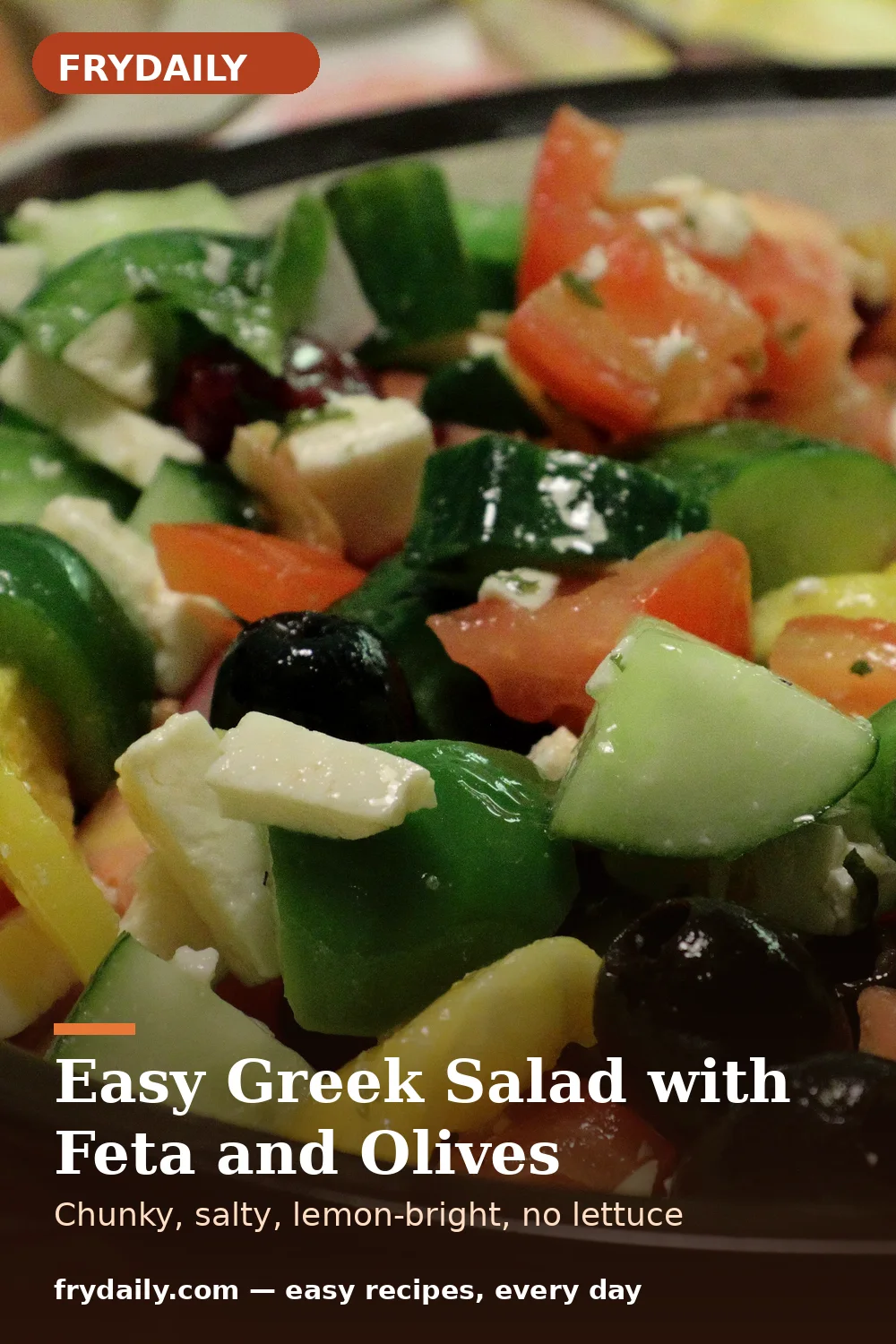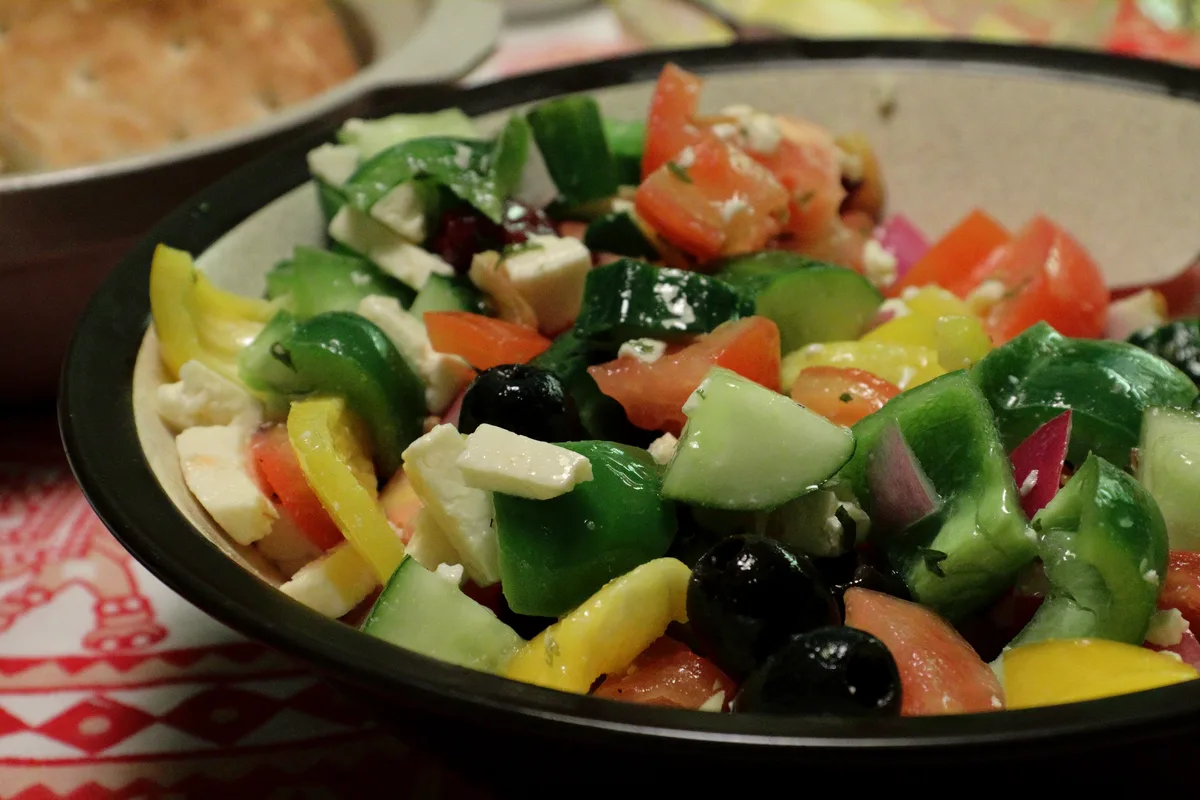
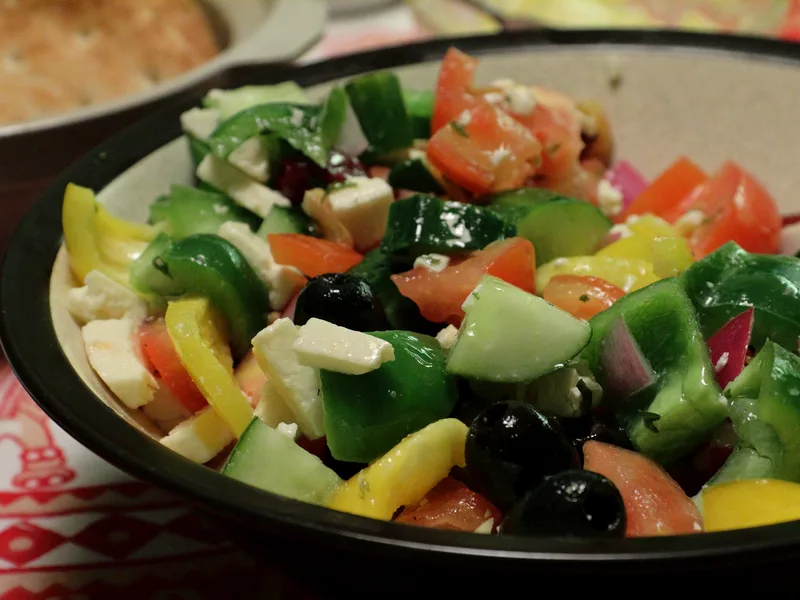
A real Greek village salad — horiatiki — has no lettuce, no little cubes and no apology: big rough chunks of tomato and cucumber, green pepper, red onion, whole black olives and feta, all glossed with olive oil, lemon and oregano, exactly as the bowl in the photograph shows. It is a salad built from ingredients that hold their shape and their juices, meant to be eaten with bread dragged through the dressing left at the bottom of the bowl.
It sits in our Healthy & Low-Carb collection next to Caprese Salad — the other no-lettuce summer bowl — and it is the side we serve most often with Lemon Herb Baked Cod and grilled chicken all summer long. Nothing is cooked, nothing is blended, and the whole thing is ready in the time it takes to chop four vegetables.
The rules are few but they matter. Cut everything chunky — small dice turns this into salsa with feta. Salt the tomatoes first and give them five minutes, so their juices join the dressing instead of watering it down. And dress the salad just before serving, then let it stand ten minutes at the table: that short rest is when the tomato juice, lemon and oil become the spoonable, bread-worthy liquor everyone fights over.
Feta: slab or cubes, but never crumbles
In Greece the feta arrives as one thick slab laid over the top, and diners break off pieces as they eat — the salad underneath stays clean and the cheese stays firm. Cubes, as in the photograph, are the practical home version and distribute the cheese through every serving. What never works is the tub of dry feta crumbles: they dissolve into the dressing, turn it cloudy and salty in patches, and disappear as an ingredient. Buy a block of feta in brine, pat it dry, and cut it into honest half-inch pieces. Sheep-and-goat feta has the tang the salad wants; cow feta is milder and a little softer, and still fine.
The dressing is the tomato juice
There is no whisked vinaigrette to make for this salad, and that is the point. The dressing builds itself in the bowl: salt draws juice from the tomatoes, lemon and olive oil emulsify loosely with it as you toss, and oregano perfumes the whole thing. This only works with ripe tomatoes — a pale, hard winter tomato gives you coloured water. In summer this salad needs nothing else; out of season, use the ripest cherry tomatoes you can find, halved, and add a teaspoon of red wine vinegar to sharpen what the fruit cannot provide.
Ingredients
- 4 large ripe tomatoes (about 800 g), cut into chunks
- 1 large English cucumber (300 g), cut into thick half-moons
- 1 medium green bell pepper (150 g), cut into chunks
- 1 small yellow bell pepper (120 g), cut into chunks
- 1/2 medium red onion (75 g), thinly sliced
- 1 cup Kalamata olives (150 g), pitted or whole
- 7 oz feta cheese (200 g), cut into cubes
- 1/4 cup extra-virgin olive oil (60 ml)
- 2 tablespoons fresh lemon juice (30 ml)
- 1 teaspoon dried oregano (1 g), plus more to finish
- 3/4 teaspoon fine salt (4 g)
- 1/2 teaspoon black pepper (1 g)
Amounts are for the yield below. US customary measures first, grams in brackets for scale users.
Step-by-step instructions
- Salt the tomatoes first. Put the tomato chunks in a large, wide bowl, sprinkle with the salt, and toss once. Leave them for 5 minutes while you chop everything else. The salt pulls out the tomato juices that will become the base of the dressing, and it seasons the tomatoes all the way through instead of only on the surface.
- Add the chunky vegetables. Add the cucumber, both peppers, the red onion and the olives to the bowl. Keep every cut chunky — pieces you can spear with a fork, nothing smaller than the olives. If your red onion is fiercely strong, rinse the slices under cold water for 20 seconds and drain well first; it takes the raw bite off without losing the crunch.
- Dress and rest. Pour the olive oil and lemon juice over the salad, add the oregano and black pepper, and toss gently with two large spoons, lifting from the bottom so the tomato juices coat everything. Rest the bowl for 10 minutes at room temperature. The juices, oil and lemon will pool into a bright, savory dressing at the bottom — that liquor is the best part of the salad.
- Top with feta and serve. Scatter the feta cubes over the top, finish with a pinch more oregano and a final thread of olive oil if you like, and serve straight from the bowl with crusty bread for the juices. Serve it as a side for six, or as a light lunch for four with warm pita.
Nutrition estimate
| Nutrient | Per serving |
|---|---|
| Calories | 215 kcal |
| Protein | 5 g |
| Carbohydrates | 10 g |
| Fat | 18 g |
| Saturated fat | 6 g |
| Sodium | 640 mg |
| Fiber | 3 g |
| Sugar | 6 g |
Nutrition figures are estimates calculated from standard ingredient data for the yield stated. Your actual values will vary with brands, substitutions and portion sizes — treat them as a guide, not a guarantee.
Storage & reheating
Greek salad is at its best within 2 hours of tossing. Leftovers keep, covered, in the refrigerator for up to 1 day — the vegetables soften and give up more juice, so drain off some liquid and refresh with a squeeze of lemon and fresh feta before serving. Do not freeze it; tomatoes and cucumber collapse completely when thawed.
Easy Greek Salad with Feta and Olives
Chunky, salty, lemon-bright — the village-style Greek salad with no lettuce at all.
Ingredients
Tick ingredients off as you prep, and tap a step below to mark it done as you cook. Scaling adjusts the listed amounts - seasoning to taste stays your call.
Instructions
- Salt the tomatoes first. Put the tomato chunks in a large, wide bowl, sprinkle with the salt, and toss once. Leave them for 5 minutes while you chop everything else. The salt pulls out the tomato juices that will become the base of the dressing, and it seasons the tomatoes all the way through instead of only on the surface.
- Add the chunky vegetables. Add the cucumber, both peppers, the red onion and the olives to the bowl. Keep every cut chunky — pieces you can spear with a fork, nothing smaller than the olives. If your red onion is fiercely strong, rinse the slices under cold water for 20 seconds and drain well first; it takes the raw bite off without losing the crunch.
- Dress and rest. Pour the olive oil and lemon juice over the salad, add the oregano and black pepper, and toss gently with two large spoons, lifting from the bottom so the tomato juices coat everything. Rest the bowl for 10 minutes at room temperature. The juices, oil and lemon will pool into a bright, savory dressing at the bottom — that liquor is the best part of the salad.
- Top with feta and serve. Scatter the feta cubes over the top, finish with a pinch more oregano and a final thread of olive oil if you like, and serve straight from the bowl with crusty bread for the juices. Serve it as a side for six, or as a light lunch for four with warm pita.
Recipe by Ahsan ul Haq · FryDaily. Printing? This card is designed to print cleanly on its own.