Brussels sprouts have a way of dividing a table, and pickling is the argument that wins over the sceptics. A short blanch takes the raw, cabbagey edge off, and then a hot, garlicky vinegar brine does the rest: the sprouts turn tangy and savoury, with a firm bite that holds up in the jar instead of going soft. After two days in the fridge they are ready to eat straight from the jar or tucked into sandwiches.
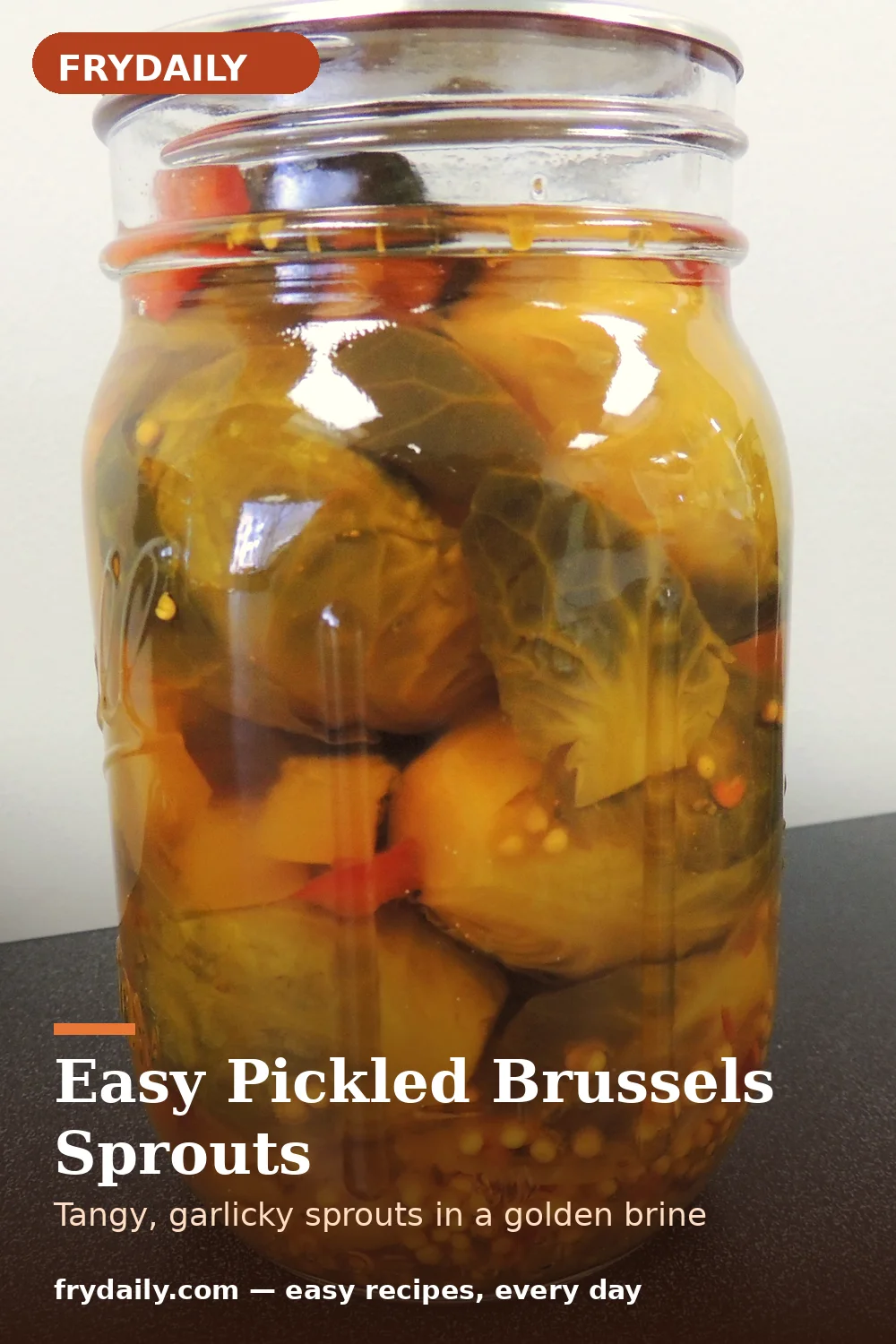
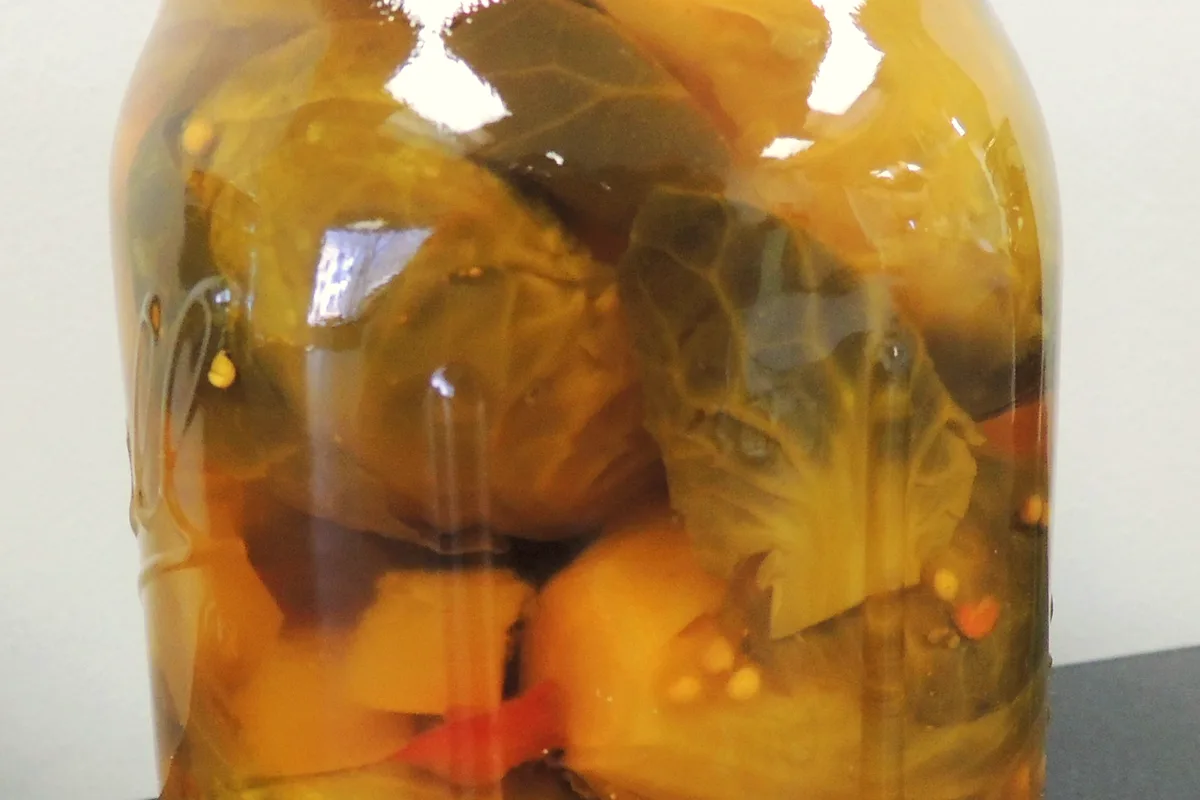
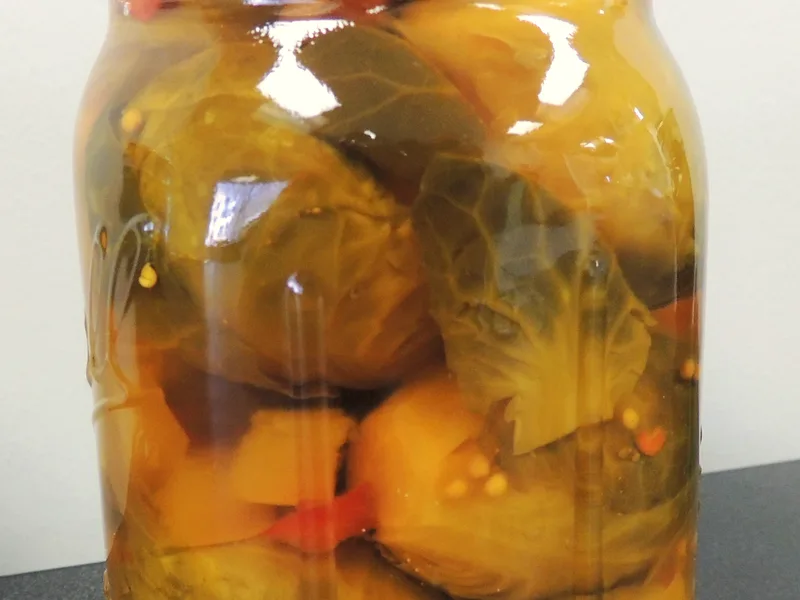
The photograph shows exactly what you are aiming for: a mason jar packed with sprouts in a clear, golden brine, mustard seeds settled at the bottom and small red pepper pieces visible through the glass. That is this recipe, jar for jar — sprouts trimmed and halved where they are large, packed in with sliced garlic, mustard seeds, black peppercorns and red pepper flakes, then covered with the hot brine while it is still steaming. The brine looks golden because the mustard seeds and pepper flakes tint it as it cools, not because anything artificial has been added.
One thing to be clear about before you start: this is a refrigerator pickle, not a shelf-stable canned jar. It lives in the fridge, it keeps for up to a month there, and it must not be stored on a pantry shelf. That makes it a good late-October project — sprouts are at their best now, and the work takes under half an hour. It joins our Canning & Preserving collection alongside our refrigerator pickled green beans, and if you like a quicker pickle, our quick pickled red onions are ready the same day.
Blanch, do not boil
The blanch is the step that decides whether these sprouts stay firm or turn to mush. Three minutes in boiling salted water is enough: the sprouts turn bright green and lose their raw edge, but a knife still meets resistance in the centre. Then straight into iced water, which stops the cooking dead. Skip the ice bath and the sprouts keep cooking in their own heat while you make the brine, and you will open a jar of soft, grey-green sprouts a week later. Small sprouts can go in whole; halve anything larger than a walnut so the brine reaches the centre, and trim only the dry end of the stem — cut too deep and the outer leaves fall off in the jar.
Do not water down the brine
The brine here is equal parts vinegar and water, with sugar and salt dissolved in, and that ratio matters. Use distilled white vinegar at 5% acidity and do not dilute it further — the acidity keeps a refrigerator pickle safe and gives it its clean tang. If you want a gentler pickle, add a little more sugar, not less vinegar. Pour the brine over the sprouts while it is hot: it softens the garlic and wakes up the mustard seeds, which is how the jar ends up golden and fragrant instead of pale and flat.
Ingredients
- 1 pound Brussels sprouts (450 g), trimmed, large ones halved
- 1 cup distilled white vinegar (240 ml), 5% acidity
- 1 cup water (240 ml)
- 2 tablespoons granulated sugar (25 g)
- 1 tablespoon kosher salt (15 g)
- 3 cloves garlic (9 g), thinly sliced
- 2 teaspoons mustard seeds (6 g)
- 1 teaspoon black peppercorns (2 g)
- 1/2 teaspoon red pepper flakes (1 g)
- 1 bay leaf
Amounts are for the yield below. US customary measures first, grams in brackets for scale users.
Step-by-step instructions
- Trim and blanch the sprouts. Trim the dry end from each sprout and peel away any yellowed outer leaves. Halve sprouts larger than a walnut through the stem so they stay together; leave small ones whole. Bring a large pot of salted water to a rolling boil and cook the sprouts for 3 minutes, no longer. Drain at once and tip them into a bowl of iced water for 5 minutes, then drain again and pat dry with a clean towel.
- Pack the jars. Divide the garlic slices, mustard seeds, black peppercorns, red pepper flakes and bay leaf between 2 clean pint jars. Pack the blanched sprouts in snugly, cut-side out where they show through the glass, leaving about 1/2 inch (1.25 cm) of headspace at the top.
- Make the brine. Combine the vinegar, water, sugar and kosher salt in a small saucepan. Bring to a simmer over medium-high heat, stirring until the sugar and salt have completely dissolved, about 2 minutes. Do not let it boil hard — a gentle simmer is enough, and a hard boil drives off vinegar and dulls the tang.
- Pour and seal. Pour the hot brine over the sprouts, tapping each jar gently on the counter to release trapped air bubbles, until the sprouts are fully submerged with about 1/2 inch (1.25 cm) of headspace. If a sprout floats above the brine, push it down with a clean spoon — anything left above the liquid will not pickle evenly. Seal the jars with clean lids and let them cool to room temperature, about 1 hour.
- Chill for 48 hours. Refrigerate the sealed jars. The sprouts are edible after 24 hours, but they taste noticeably better at 48 hours, once the brine has worked into the centres and the mustard seeds have tinted the liquid golden, just as in the photograph. Keep the jars in the refrigerator the whole time; this is not a shelf-stable pickle.
- Serve cold from the jar. Lift the sprouts out with a clean fork, letting the brine drip back into the jar, and serve them cold. They are excellent on a cheese board, sliced into salads, piled into sandwiches, or served whole as a sharp side with roast pork or sausages.
Nutrition estimate
| Nutrient | Per serving |
|---|---|
| Calories | 35 kcal |
| Protein | 2 g |
| Carbohydrates | 7 g |
| Fat | 0 g |
| Saturated fat | 0 g |
| Sodium | 480 mg |
| Fiber | 2 g |
| Sugar | 4 g |
Nutrition figures are estimates calculated from standard ingredient data for the yield stated. Your actual values will vary with brands, substitutions and portion sizes — treat them as a guide, not a guarantee.
Storage & reheating
Kept sealed in the refrigerator, with the sprouts always submerged in brine, these pickles keep for up to 1 month. Use a clean fork every time you take sprouts out, and discard the jar if the brine turns cloudy with an off smell or any mould appears — a refrigerator pickle is not shelf-stable, so do not store it in the pantry and do not try to water-bath can this recipe. Nutrition figures are estimates per serving and vary with how much brine the sprouts absorb; estimates vary.
Canning safety — read first
Home canning must follow tested processes exactly. The times on this page follow the structure of current USDA guidance for the stated jar size at 0-1,000 feet elevation; always confirm processing times and altitude adjustments in the USDA Complete Guide to Home Canning or the National Center for Home Food Preservation before you start. Never taste food from a jar with a failed seal, bulging lid or off odor — discard it.
Easy Pickled Brussels Sprouts
Tangy, garlicky sprouts in a golden brine.
Ingredients
Tick ingredients off as you prep, and tap a step below to mark it done as you cook. Scaling adjusts the listed amounts - seasoning to taste stays your call.
Instructions
- Trim and blanch the sprouts. Trim the dry end from each sprout and peel away any yellowed outer leaves. Halve sprouts larger than a walnut through the stem so they stay together; leave small ones whole. Bring a large pot of salted water to a rolling boil and cook the sprouts for 3 minutes, no longer. Drain at once and tip them into a bowl of iced water for 5 minutes, then drain again and pat dry with a clean towel.
- Pack the jars. Divide the garlic slices, mustard seeds, black peppercorns, red pepper flakes and bay leaf between 2 clean pint jars. Pack the blanched sprouts in snugly, cut-side out where they show through the glass, leaving about 1/2 inch (1.25 cm) of headspace at the top.
- Make the brine. Combine the vinegar, water, sugar and kosher salt in a small saucepan. Bring to a simmer over medium-high heat, stirring until the sugar and salt have completely dissolved, about 2 minutes. Do not let it boil hard — a gentle simmer is enough, and a hard boil drives off vinegar and dulls the tang.
- Pour and seal. Pour the hot brine over the sprouts, tapping each jar gently on the counter to release trapped air bubbles, until the sprouts are fully submerged with about 1/2 inch (1.25 cm) of headspace. If a sprout floats above the brine, push it down with a clean spoon — anything left above the liquid will not pickle evenly. Seal the jars with clean lids and let them cool to room temperature, about 1 hour.
- Chill for 48 hours. Refrigerate the sealed jars. The sprouts are edible after 24 hours, but they taste noticeably better at 48 hours, once the brine has worked into the centres and the mustard seeds have tinted the liquid golden, just as in the photograph. Keep the jars in the refrigerator the whole time; this is not a shelf-stable pickle.
- Serve cold from the jar. Lift the sprouts out with a clean fork, letting the brine drip back into the jar, and serve them cold. They are excellent on a cheese board, sliced into salads, piled into sandwiches, or served whole as a sharp side with roast pork or sausages.
Recipe by Ahsan ul Haq · FryDaily. Printing? This card is designed to print cleanly on its own.