Spaghetti squash is the rare vegetable that actually earns its pasta comparison. Roasted cut-side down, its flesh pulls apart into long, tender strands that hold sauce the way noodles do, without the heavy, sleepy feeling of a big bowl of pasta. Under a chunky marinara — tomatoes, garlic, onion and herbs, cooked just long enough to come together — it is a weeknight dinner that tastes like pasta night and leaves you feeling like you ate vegetables, because you did.
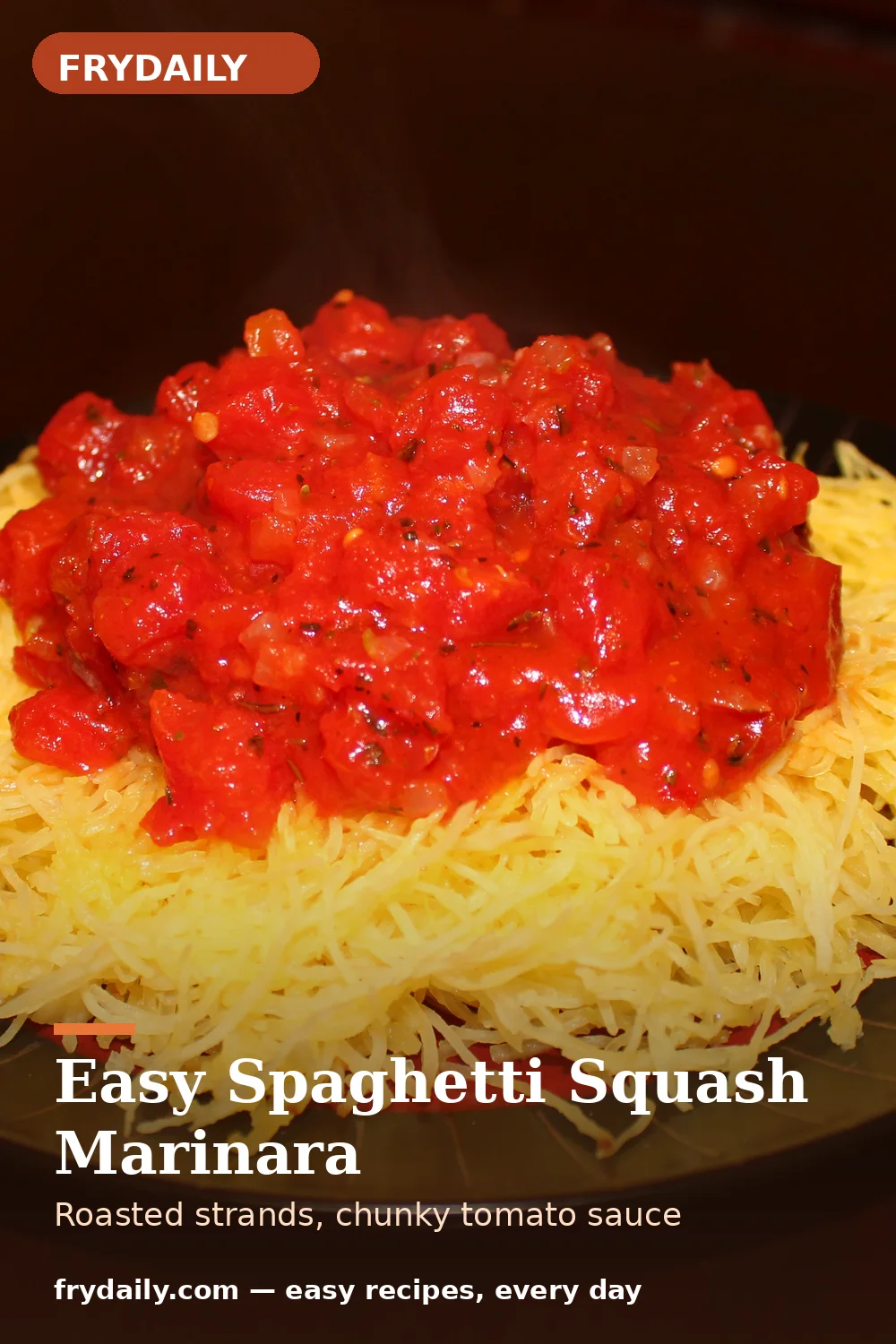
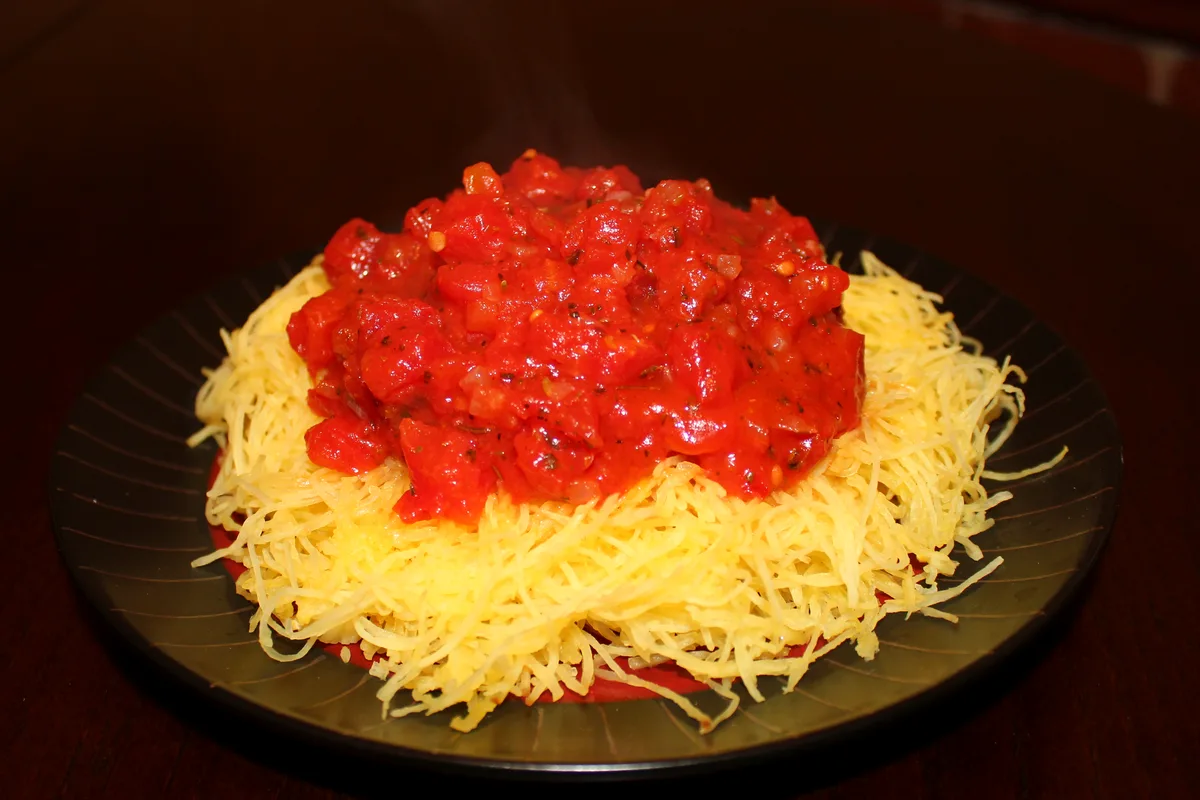
The trick is entirely in the roast. A squash roasted cut-side up steams in its own hollow and turns to mush; cut-side down, the flesh dries out just enough to strand cleanly, and the cut edges caramelize a little at the rim. Then, and this matters, you scrape with a fork along the width of the squash, not down its length. Scraping across the fibers gives you the long strands you see in the photograph. Scraping the wrong way gives you short, broken bits that eat like mashed squash.
It sits in our Healthy and Low-Carb collection next to our classic ratatouille, another vegetable-forward dinner that never feels like a compromise, and it pairs naturally with our garlic herb shrimp zucchini skillet when you want a little protein on the side. One medium squash feeds four as a main, and the sauce is a pantry sauce — canned tomatoes, garlic, onion — so this is a dinner you can make on a night when the fridge looks empty.
How to pick a squash that will strand well
Choose a squash that feels heavy for its size, with hard, unblemished skin and no soft spots — a light squash is often an old, dried-out one, and its strands will be thin and stringy. The best size for this recipe is about 3 pounds; much bigger and it will not fit a standard sheet pan cut-side down, much smaller and you will not get four servings. If the squash rocks on the counter, slice a thin sliver off one side to steady it before you halve it — a wobbling squash and a big knife are a bad combination.
Keep the sauce chunky on purpose
This is not a smooth jarred sauce, and it should not try to be. Crushed tomatoes plus a can of diced tomatoes, cooked for only about 20 minutes, keep their shape and their bright tomato flavour, and the chunks cling to the squash strands instead of sliding off into a puddle. If your sauce looks watery after simmering, turn the heat up for the last five minutes and let it reduce — the squash itself releases a little moisture, and a sauce that was perfect in the pan can thin out on the plate.
Ingredients
- 1 medium spaghetti squash (about 3 pounds) (1.4 kg)
- 1 tablespoon olive oil (15 ml)
- 1/2 teaspoon fine sea salt (3 g)
- 1/4 teaspoon black pepper (0.5 g)
- 1 tablespoon olive oil (15 ml)
- 1 small yellow onion, finely diced (110 g)
- 4 cloves garlic, thinly sliced (12 g)
- 1 (28 oz) can crushed tomatoes (794 g)
- 1 (14 oz) can diced tomatoes, drained (397 g)
- 1 teaspoon dried oregano (2 g)
- 1/2 teaspoon dried basil (1 g)
- 1/4 teaspoon red pepper flakes (0.5 g), optional
- 1 tablespoon tomato paste (16 g)
- 1 teaspoon sugar (4 g), optional
- 1/4 cup chopped fresh basil (10 g), for serving
Amounts are for the yield below. US customary measures first, grams in brackets for scale users.
Step-by-step instructions
- Heat the oven and halve the squash. Heat the oven to 400°F (204°C). Halve the spaghetti squash lengthwise with a large, sharp knife, rocking the blade carefully through the stem end. Scoop out the seeds and stringy pulp with a spoon. Rub the cut sides with the first tablespoon of olive oil and season with the salt and pepper.
- Roast cut-side down. Place the halves cut-side down on a rimmed baking sheet lined with parchment. Roast for 35 to 40 minutes, until the skin gives slightly when pressed and a fork slides easily into the flesh. Do not over-roast: a squash that collapses when you lift it has gone past strands and into mash.
- Start the sauce while the squash roasts. While the squash is in the oven, warm the second tablespoon of olive oil in a large skillet over medium heat. Cook the onion with a pinch of salt for 5 minutes, until soft and translucent, then add the garlic and cook 1 minute more, until fragrant but not browned — browned garlic turns bitter and will spoil the whole sauce.
- Simmer the chunky marinara. Stir in the tomato paste and cook for 1 minute, then add both cans of tomatoes, the oregano, dried basil and red pepper flakes. Simmer gently for 20 minutes, stirring occasionally, until thickened enough to mound on a spoon. Taste and add the sugar only if your tomatoes are sharp — good canned tomatoes often need none.
- Scrape the squash into strands. When the squash is cool enough to handle, hold each half with a towel and drag a fork across the width of the flesh, not down its length. The strands should pull away easily in long threads. If any part resists, it needs a few more minutes in the oven — return it cut-side down rather than forcing it.
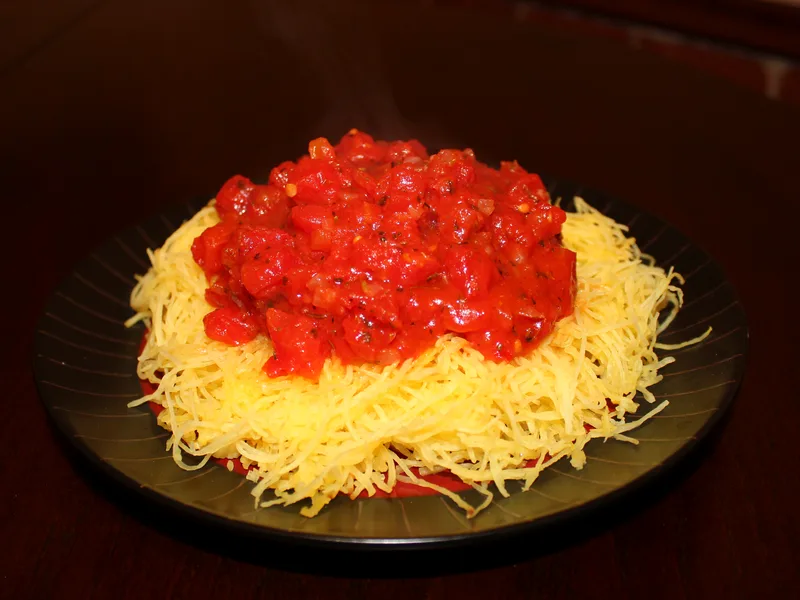
- Serve the sauce over the strands. Divide the squash strands among warm bowls and ladle the chunky marinara over the top, as in the photograph, rather than tossing it all together — the sauce stays bright and the strands stay distinct. Scatter with fresh basil and serve at once, while the squash is still steaming.
Nutrition estimate
| Nutrient | Per serving |
|---|---|
| Calories | 165 kcal |
| Protein | 3 g |
| Carbohydrates | 24 g |
| Fat | 7 g |
| Saturated fat | 1 g |
| Sodium | 480 mg |
| Fiber | 5 g |
| Sugar | 11 g |
Nutrition figures are estimates calculated from standard ingredient data for the yield stated. Your actual values will vary with brands, substitutions and portion sizes — treat them as a guide, not a guarantee.
Storage & reheating
Store the squash and sauce separately in airtight containers in the refrigerator for up to 4 days; the squash keeps its strands far better apart from the sauce. Reheat the squash in a dry skillet over medium heat for 3 minutes and warm the sauce separately, then combine. Freeze the sauce alone for up to 3 months; frozen squash goes watery and is not worth it. Nutrition figures are estimates from standard ingredient data and vary with brands and substitutions.
Easy Spaghetti Squash Marinara
Roasted strands, chunky tomato sauce — pasta night, lighter.
Ingredients
Tick ingredients off as you prep, and tap a step below to mark it done as you cook. Scaling adjusts the listed amounts - seasoning to taste stays your call.
Instructions
- Heat the oven and halve the squash. Heat the oven to 400°F (204°C). Halve the spaghetti squash lengthwise with a large, sharp knife, rocking the blade carefully through the stem end. Scoop out the seeds and stringy pulp with a spoon. Rub the cut sides with the first tablespoon of olive oil and season with the salt and pepper.
- Roast cut-side down. Place the halves cut-side down on a rimmed baking sheet lined with parchment. Roast for 35 to 40 minutes, until the skin gives slightly when pressed and a fork slides easily into the flesh. Do not over-roast: a squash that collapses when you lift it has gone past strands and into mash.
- Start the sauce while the squash roasts. While the squash is in the oven, warm the second tablespoon of olive oil in a large skillet over medium heat. Cook the onion with a pinch of salt for 5 minutes, until soft and translucent, then add the garlic and cook 1 minute more, until fragrant but not browned — browned garlic turns bitter and will spoil the whole sauce.
- Simmer the chunky marinara. Stir in the tomato paste and cook for 1 minute, then add both cans of tomatoes, the oregano, dried basil and red pepper flakes. Simmer gently for 20 minutes, stirring occasionally, until thickened enough to mound on a spoon. Taste and add the sugar only if your tomatoes are sharp — good canned tomatoes often need none.
- Scrape the squash into strands. When the squash is cool enough to handle, hold each half with a towel and drag a fork across the width of the flesh, not down its length. The strands should pull away easily in long threads. If any part resists, it needs a few more minutes in the oven — return it cut-side down rather than forcing it.
- Serve the sauce over the strands. Divide the squash strands among warm bowls and ladle the chunky marinara over the top, as in the photograph, rather than tossing it all together — the sauce stays bright and the strands stay distinct. Scatter with fresh basil and serve at once, while the squash is still steaming.
Recipe by Ahsan ul Haq · FryDaily. Printing? This card is designed to print cleanly on its own.