Apple pie carries more expectation per slice than any other dessert in America, and most of that expectation is really about two things: a crust that flakes instead of steaming into leather, and a filling that holds its shape on the plate instead of flooding it. This recipe is engineered for exactly those two outcomes, and it takes one honest shortcut to get there — a good refrigerated double crust — while spending its effort where effort pays: the apple mixture, the thickener balance, and the cooling time that nobody wants to wait for and everybody should.
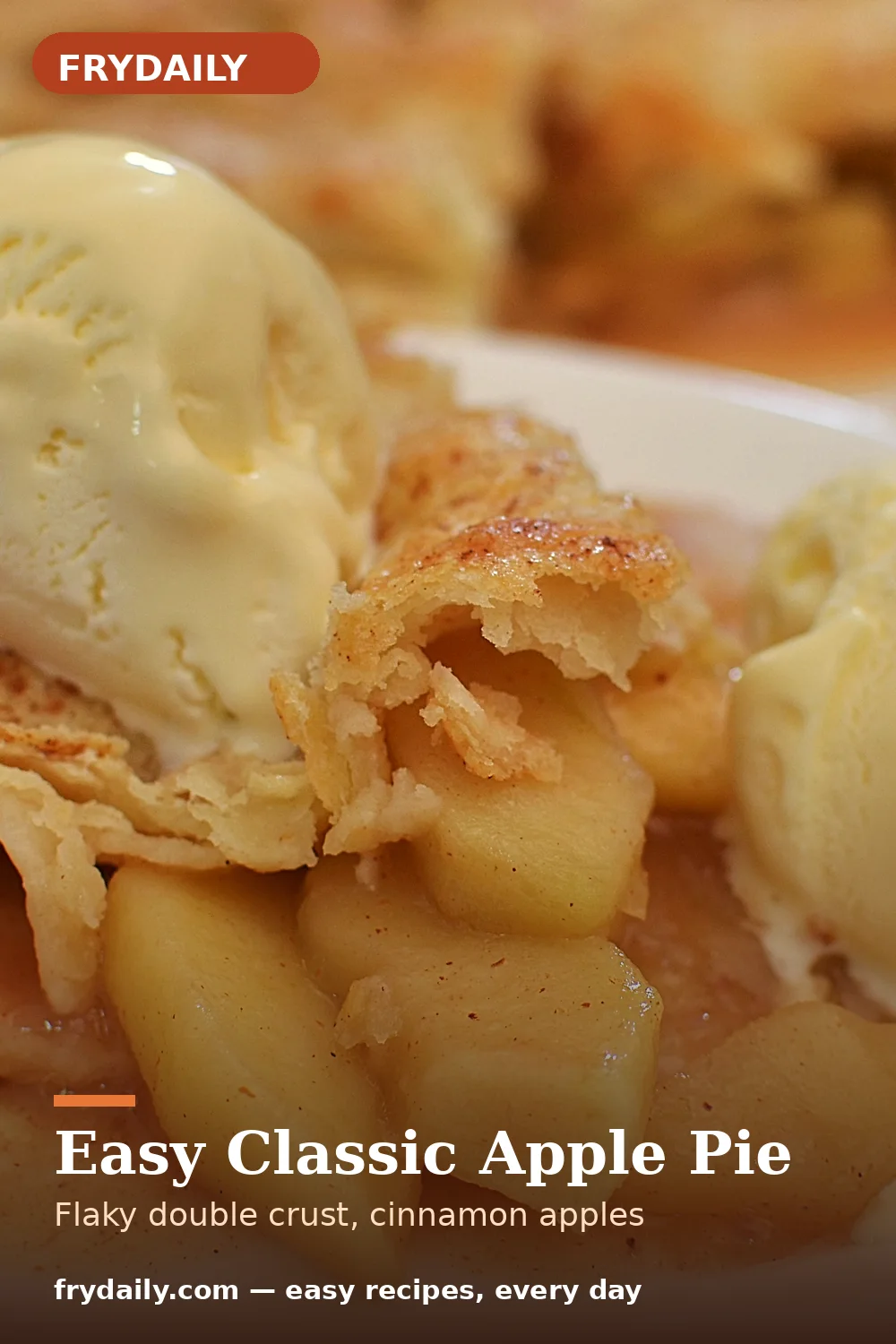
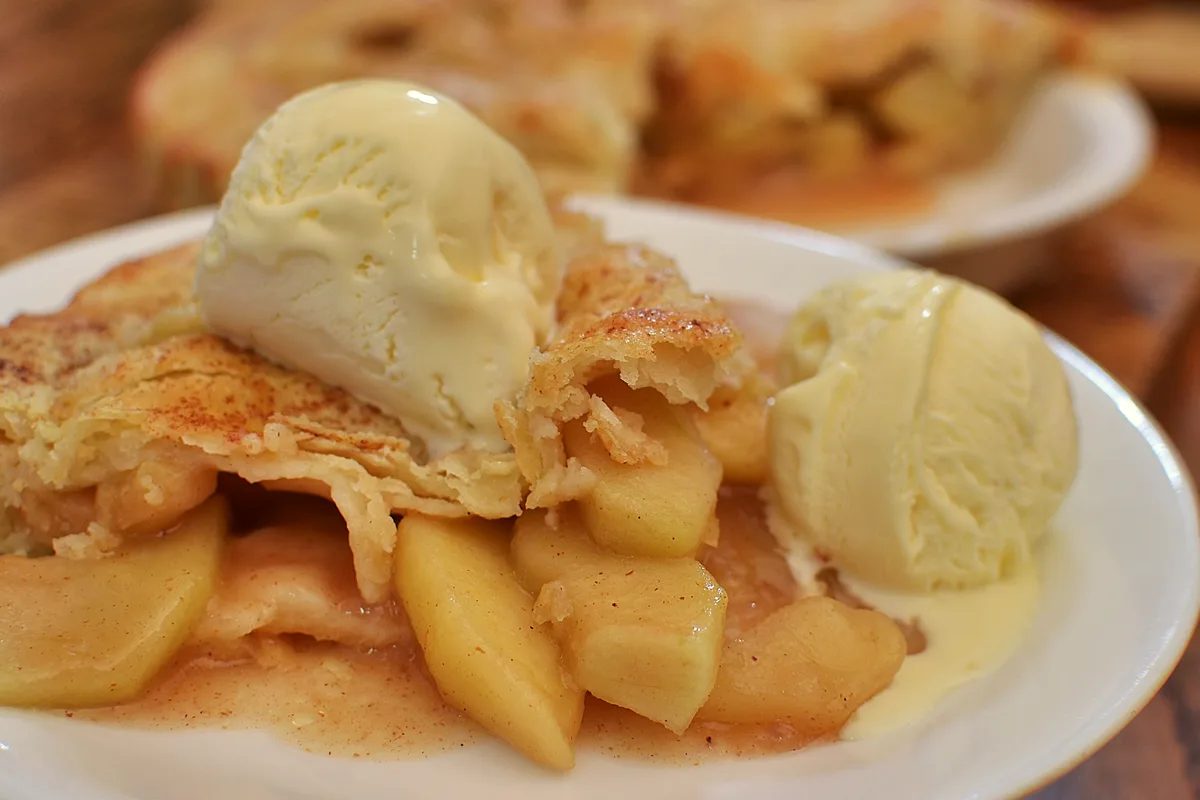
It is the baked centrepiece of our Desserts collection, and it has a natural partner elsewhere on the site: our Canned Apple Pie Filling exists precisely so a pie like this can happen in February; our Peach Cobbler is the faster route to the same comfort. The photograph tells the truth about how this pie is served around here — warm, with a scoop of vanilla ice cream going soft at the edges of the slice.
Two apple varieties are non-negotiable in this kitchen. One firm, tart apple to hold its shape and keep the filling bright, and one sweeter, softer apple to slump into the sauce between the slices. A single-variety pie is either all mush or all crunch; the mixture is what makes each forkful taste complete.
The maceration step does three jobs
Tossing the sliced apples with sugar, lemon and spices and letting them stand for thirty minutes looks like idle time and is anything but. The sugar pulls a bowlful of juice out of the apples — juice that, baked into the pie raw, is exactly what makes a filling flood and a bottom crust soggy. Here, that juice is drained, thickened with the flour, and returned as a controlled amount of liquid, so the filling sets into a glossy sauce instead of a puddle. Macerating also seasons the apples to their centres rather than just their surfaces, and slightly wilts the slices so they pack into the crust without the air pockets that collapse into a shrunken filling and a domed, hollow top crust.
Cooling is an ingredient
A pie cut warm is a pie served as sauce with crust fragments — delicious, but not a slice. The filling's thickeners finish setting as the pie cools, and the difference between a two-hour rest and a four-hour rest is visible on every plate. If warm pie is the whole point, cool it the full four hours, then warm the cut slices — set filling, crisp crust, melting ice cream, no compromises anywhere.
Ingredients
- 2 refrigerated pie crusts (one 14.1 oz package / 400 g), at cool room temperature
- 3 lb mixed apples (1.35 kg), about 6 large — half Granny Smith, half Honeycrisp or Fuji
- 3/4 cup granulated sugar (150 g)
- 1/4 cup all-purpose flour (30 g)
- 1 teaspoon ground cinnamon (2.5 g)
- 1/4 teaspoon ground nutmeg (0.6 g)
- 1/4 teaspoon kosher salt (1.5 g)
- 1 tablespoon fresh lemon juice (15 ml)
- 1 teaspoon vanilla extract (5 ml)
- 1 tablespoon unsalted butter (14 g), cut into small pieces
- 1 large egg beaten with 1 tablespoon milk (15 ml), for the wash
- 1 tablespoon coarse sugar (12 g), for the top, optional
Amounts are for the yield below. US customary measures first, grams in brackets for scale users.
Step-by-step instructions
- Slice and macerate the apples. Peel, core and slice the apples into even 1/4 inch (6 mm) slices — even slices cook at the same rate, which is what keeps some from collapsing while others stay raw. Toss them in a large bowl with the granulated sugar, cinnamon, nutmeg, salt, lemon juice and vanilla, and leave for 30 minutes, stirring once or twice. The bowl will fill with juice; that is the plan.
- Line the pie plate. Ease one crust into a 9 inch (23 cm) pie plate, pressing it gently into the corners without stretching it — stretched dough shrinks back in the oven. Leave the overhang. Put the lined plate in the refrigerator while the apples finish macerating; cold crust meeting a hot oven is the first defence of a crisp bottom.
- Drain, thicken, refill. Tip the apples into a colander over the bowl and let the juice drain for a few minutes. Whisk the flour into the drained juice until smooth, then pour it back over the apples and toss until every slice is coated. The filling should look glossy and just-saucy, not wet — this drained-and-thickened juice is the difference between a slice that stands and one that floods.
- Fill and top the pie. Pile the apples into the chilled crust, mounding them slightly in the centre and pressing gently so there are no big air pockets. Dot the top with the butter pieces. Lay the second crust over the filling, trim the overhang to about 1/2 inch (1.25 cm), fold the edge under itself, and crimp with your fingers or a fork. Cut four or five slits in the top so steam can escape in streams instead of bursting the seam.
- Egg wash and bake. Brush the top with the egg wash and sprinkle with the coarse sugar, if using. Bake at 425°F (220°C) for 20 minutes, then reduce the heat to 375°F (190°C) and bake for 35 to 40 minutes more, until the crust is deep golden and the filling bubbles thickly through the slits — the bubbles should be slow and lazy, which is how you know the thickener has done its work. Shield the crimped edge with foil for the last stretch if it browns early.
- Cool completely, then slice. Cool the pie on a rack for at least 3 hours, and 4 is better — this is when the filling sets into clean slices, and cutting early undoes the whole recipe. Serve slices at room temperature or gently rewarmed, with vanilla ice cream, as in the photograph.
Nutrition estimate
| Nutrient | Per serving |
|---|---|
| Calories | 356 kcal |
| Protein | 3 g |
| Carbohydrates | 58 g |
| Fat | 13 g |
| Saturated fat | 5 g |
| Sodium | 240 mg |
| Fiber | 4 g |
| Sugar | 34 g |
Nutrition figures are estimates calculated from standard ingredient data for the yield stated. Your actual values will vary with brands, substitutions and portion sizes — treat them as a guide, not a guarantee.
Storage & reheating
Apple pie keeps, covered, at room temperature for up to 2 days and in the refrigerator for up to 4 — refrigeration firms the crust slightly, so reheat slices in a 350°F (177°C) oven for 10 to 12 minutes to re-crisp before serving. The whole pie freezes well for up to 3 months, wrapped tightly; thaw overnight in the fridge and reheat, covered, until warmed through. An unbaked, assembled pie also freezes beautifully: bake it straight from frozen, adding about 20 minutes to the total bake time.
Easy Classic Apple Pie
Flaky double crust, cinnamon apples, slices that hold — pie the classic way.
Ingredients
Tick ingredients off as you prep, and tap a step below to mark it done as you cook. Scaling adjusts the listed amounts - seasoning to taste stays your call.
Instructions
- Slice and macerate the apples. Peel, core and slice the apples into even 1/4 inch (6 mm) slices — even slices cook at the same rate, which is what keeps some from collapsing while others stay raw. Toss them in a large bowl with the granulated sugar, cinnamon, nutmeg, salt, lemon juice and vanilla, and leave for 30 minutes, stirring once or twice. The bowl will fill with juice; that is the plan.
- Line the pie plate. Ease one crust into a 9 inch (23 cm) pie plate, pressing it gently into the corners without stretching it — stretched dough shrinks back in the oven. Leave the overhang. Put the lined plate in the refrigerator while the apples finish macerating; cold crust meeting a hot oven is the first defence of a crisp bottom.
- Drain, thicken, refill. Tip the apples into a colander over the bowl and let the juice drain for a few minutes. Whisk the flour into the drained juice until smooth, then pour it back over the apples and toss until every slice is coated. The filling should look glossy and just-saucy, not wet — this drained-and-thickened juice is the difference between a slice that stands and one that floods.
- Fill and top the pie. Pile the apples into the chilled crust, mounding them slightly in the centre and pressing gently so there are no big air pockets. Dot the top with the butter pieces. Lay the second crust over the filling, trim the overhang to about 1/2 inch (1.25 cm), fold the edge under itself, and crimp with your fingers or a fork. Cut four or five slits in the top so steam can escape in streams instead of bursting the seam.
- Egg wash and bake. Brush the top with the egg wash and sprinkle with the coarse sugar, if using. Bake at 425°F (220°C) for 20 minutes, then reduce the heat to 375°F (190°C) and bake for 35 to 40 minutes more, until the crust is deep golden and the filling bubbles thickly through the slits — the bubbles should be slow and lazy, which is how you know the thickener has done its work. Shield the crimped edge with foil for the last stretch if it browns early.
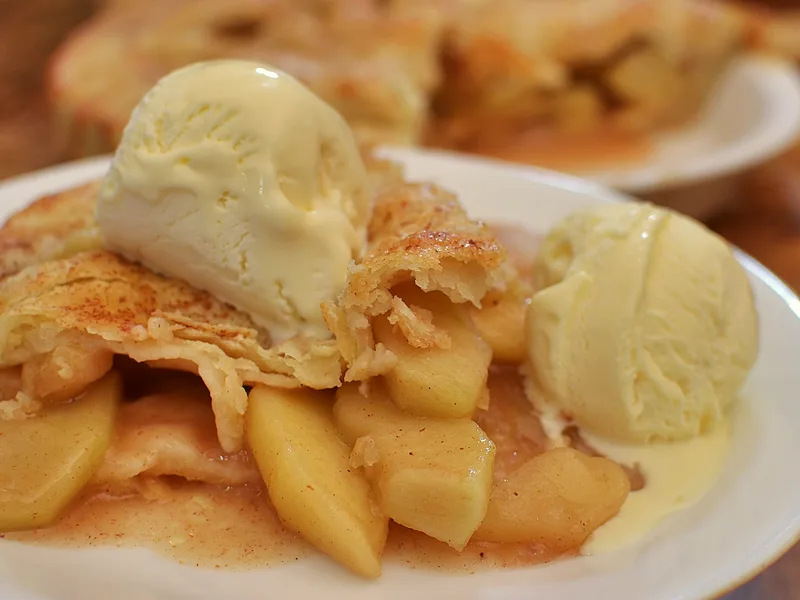
- Cool completely, then slice. Cool the pie on a rack for at least 3 hours, and 4 is better — this is when the filling sets into clean slices, and cutting early undoes the whole recipe. Serve slices at room temperature or gently rewarmed, with vanilla ice cream, as in the photograph.
Recipe by Ahsan ul Haq · FryDaily. Printing? This card is designed to print cleanly on its own.