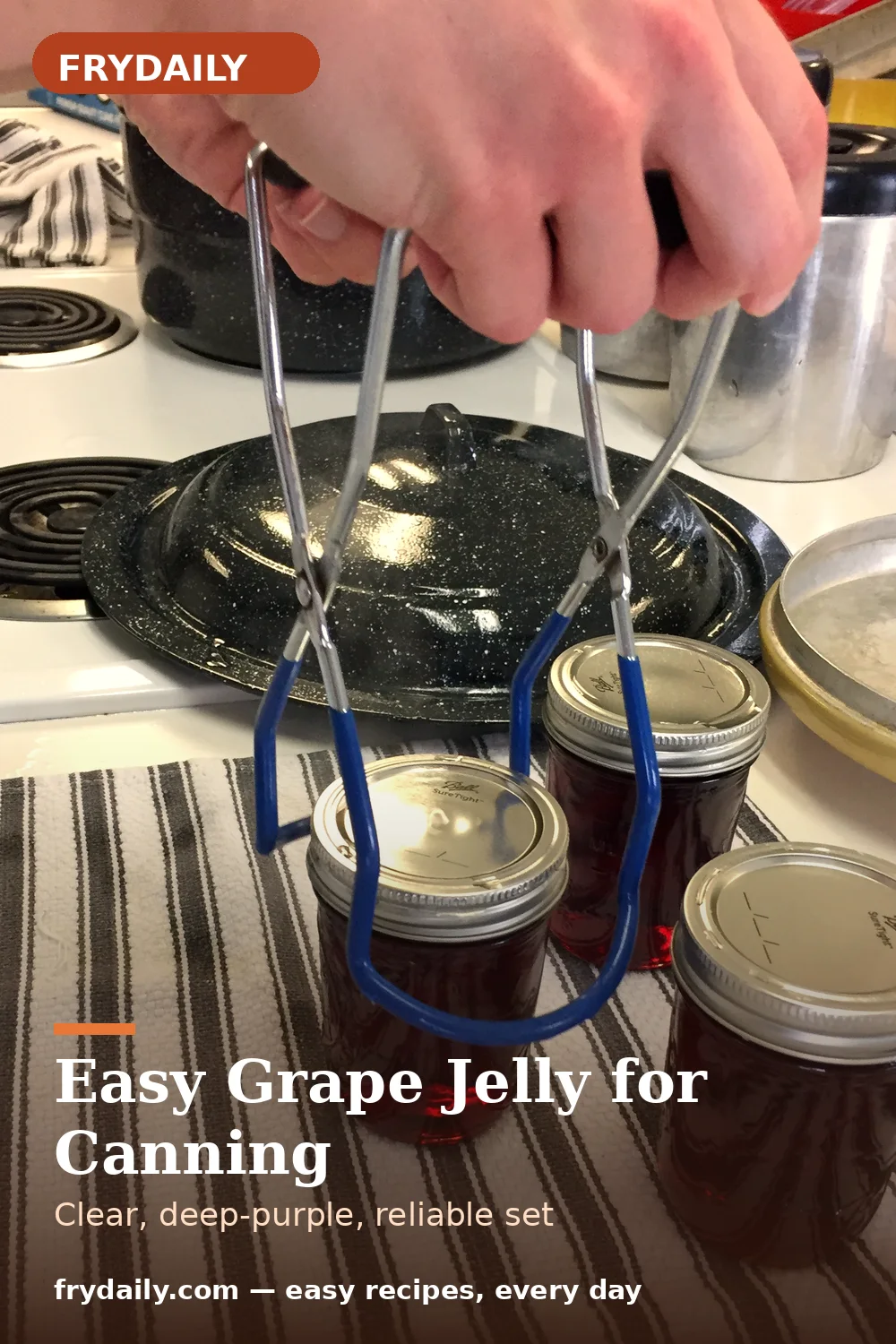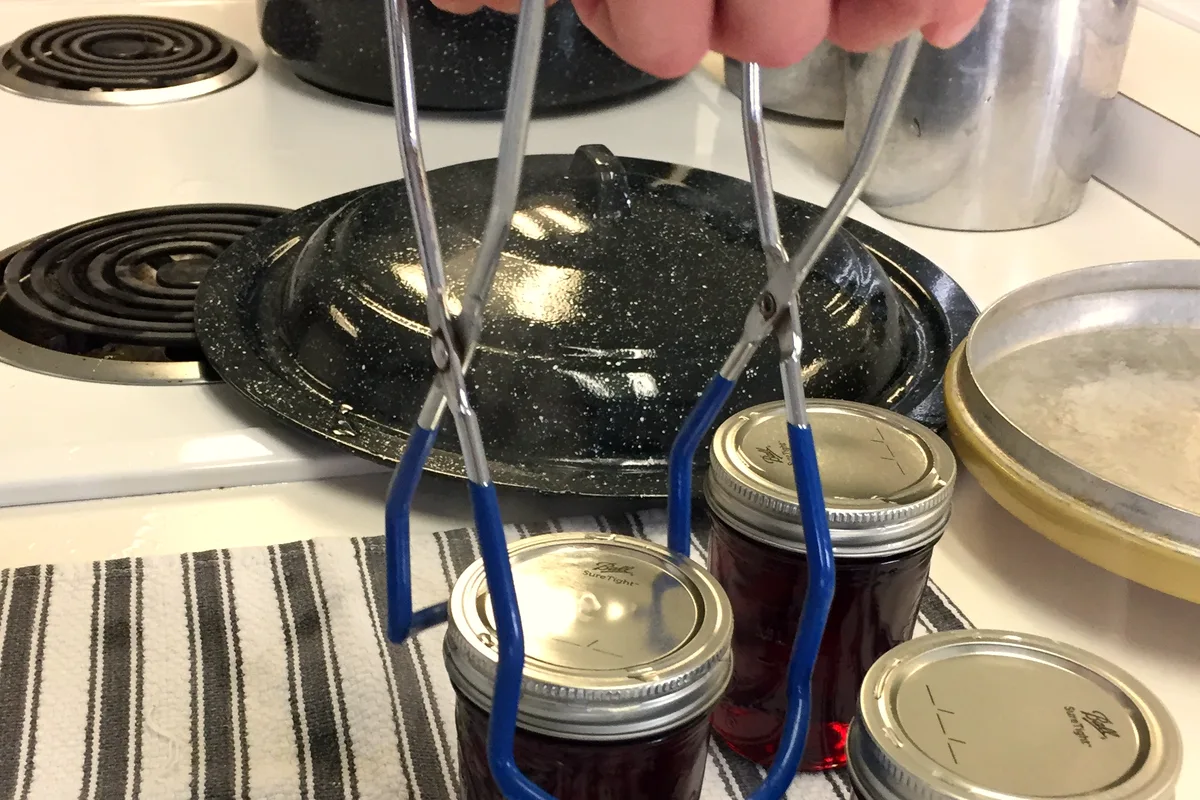
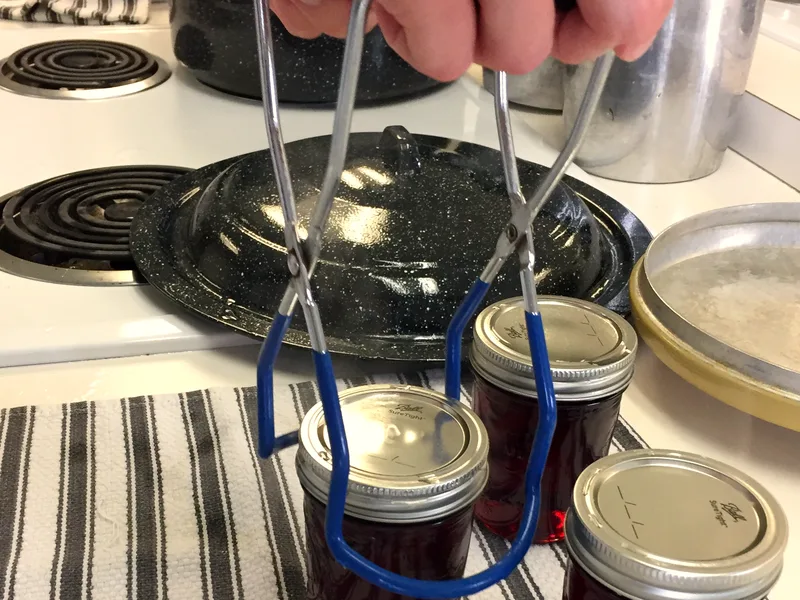
Grape jelly is the jar that disappears first, and the photograph tells the best part of the story: a finished jar of deep purple jelly being lifted, steaming, onto the towel to cool. This recipe uses bottled Concord grape juice — the honest shortcut that puts jelly within reach outside grape season and gives a set you can rely on — plus powdered pectin measured and timed the way the pectin makers specify. It joins our Canning & Preserving shelf next to Blueberry Jam, and the safety notes on this page apply to it in full.
Clarity is the difference between good grape jelly and great grape jelly, and clarity is decided before the pot boils. Bottled juice has already been strained and settled, which is why juice-based jelly comes out jewel-clear while rushed home-pressed juice can set cloudy. If you do press your own grapes, let the juice rest overnight in the fridge and ladle it off its sediment before measuring — the tartrate crystals left behind are also what form gritty specks in finished jelly.
The set itself is not luck. Powdered pectin needs a full, rolling boil that cannot be stirred down, a precise minute at that boil, and — this is where batches fail — sugar added in the right order and measured level, not heaped. Follow the sequence below exactly and the jelly will sheet off the spoon by the end of the minute and set firm by morning.
The spoon test, and trusting the timer
Old cookbooks judge jelly by whether it sheets off a cold spoon in two merging drips. It is a lovely test and a terrible timer: by the time a new jelly maker sees the sheet, the batch is often thirty seconds overcooked and heading for syrup-in-reverse — a set so hard it bounces. With powdered pectin, trust the clock instead: exactly one minute at a boil you cannot stir down. Dip the spoon at the end if you like, for the pleasure of seeing it work, not to decide anything.
Skimming and the half-inch of foam
A kettle of jelly throws foam as it boils, and foam ladled into jars turns into cloudy white rafts on the surface. The old fix still works: stir in half a teaspoon of butter at the start — it breaks the surface tension and most batches throw almost no foam at all. Whatever foam remains, skim it with a clean spoon just before filling the jars, and eat the skimmings on toast standing at the stove. That is the cook's portion and it is non-negotiable.
Ingredients
- 4 cups bottled Concord grape juice (950 ml), unsweetened
- 1 (1.75 oz) package powdered fruit pectin (49 g)
- 5 cups granulated sugar (1 kg), measured and set aside
- 1/2 teaspoon butter (2.5 g), optional, to reduce foaming
Amounts are for the yield below. US customary measures first, grams in brackets for scale users.
Step-by-step instructions
- Prepare the jars and canner. Wash 8 half-pint jars and keep them hot. Fill a water-bath canner halfway, set the jars' lids in warm (not boiling) water, and bring the canner toward a simmer so everything is ready when the jelly is.
- Combine juice and pectin. Pour the grape juice into a large, deep pot. Whisk in the powdered pectin until fully dissolved, add the butter if using, and bring to a full rolling boil over high heat, stirring constantly.
- Add the sugar at once. Pour in all the measured sugar in one addition and stir until dissolved. Return the pot to a full rolling boil — one that does not stop when stirred.
- Boil hard for exactly one minute. Hold the full rolling boil for exactly 1 minute, stirring constantly, then remove the pot from the heat immediately. Skim any foam quickly with a clean metal spoon.
- Fill the jars. Ladle hot jelly into hot half-pint jars, leaving 1/4 inch (0.6 cm) headspace. Wipe the rims clean, apply lids and bands fingertip-tight.
- Process and cool. Process in a boiling water bath for 10 minutes at 0–1,000 feet elevation, adjusting for altitude per USDA guidance. Rest the jars on a towel for 12 to 24 hours; the jelly may take up to 2 days to set fully. Check seals before labelling.
Nutrition estimate
| Nutrient | Per serving |
|---|---|
| Calories | 56 kcal |
| Protein | 0 g |
| Carbohydrates | 14 g |
| Fat | 0 g |
| Saturated fat | 0 g |
| Sodium | 1 mg |
| Fiber | 0 g |
| Sugar | 14 g |
Nutrition figures are estimates calculated from standard ingredient data for the yield stated. Your actual values will vary with brands, substitutions and portion sizes — treat them as a guide, not a guarantee.
Storage & reheating
Sealed jars keep in a cool, dark cupboard and are best within 12 months. Once opened, refrigerate and use within 1 month. Nutrition is estimated per 1-tablespoon serving; estimates vary with the juice used. If a batch under-sets after 2 days, the jars are still safe if sealed — serve the soft jelly as a syrup over pancakes or ice cream, or reprocess it following the pectin maker's remake directions. Discard any jar with a failed seal or off smell without tasting.
Canning safety — read first
Home canning must follow tested processes exactly. The times on this page follow the structure of current USDA guidance for the stated jar size at 0-1,000 feet elevation; always confirm processing times and altitude adjustments in the USDA Complete Guide to Home Canning or the National Center for Home Food Preservation before you start. Never taste food from a jar with a failed seal, bulging lid or off odor — discard it.
Easy Grape Jelly for Canning
Clear, deep-purple grape jelly with a set you can trust, in half-pint jars.
Ingredients
Tick ingredients off as you prep, and tap a step below to mark it done as you cook. Scaling adjusts the listed amounts - seasoning to taste stays your call.
Instructions
- Prepare the jars and canner. Wash 8 half-pint jars and keep them hot. Fill a water-bath canner halfway, set the jars' lids in warm (not boiling) water, and bring the canner toward a simmer so everything is ready when the jelly is.
- Combine juice and pectin. Pour the grape juice into a large, deep pot. Whisk in the powdered pectin until fully dissolved, add the butter if using, and bring to a full rolling boil over high heat, stirring constantly.
- Add the sugar at once. Pour in all the measured sugar in one addition and stir until dissolved. Return the pot to a full rolling boil — one that does not stop when stirred.
- Boil hard for exactly one minute. Hold the full rolling boil for exactly 1 minute, stirring constantly, then remove the pot from the heat immediately. Skim any foam quickly with a clean metal spoon.
- Fill the jars. Ladle hot jelly into hot half-pint jars, leaving 1/4 inch (0.6 cm) headspace. Wipe the rims clean, apply lids and bands fingertip-tight.
- Process and cool. Process in a boiling water bath for 10 minutes at 0–1,000 feet elevation, adjusting for altitude per USDA guidance. Rest the jars on a towel for 12 to 24 hours; the jelly may take up to 2 days to set fully. Check seals before labelling.
Recipe by Ahsan ul Haq · FryDaily. Printing? This card is designed to print cleanly on its own.