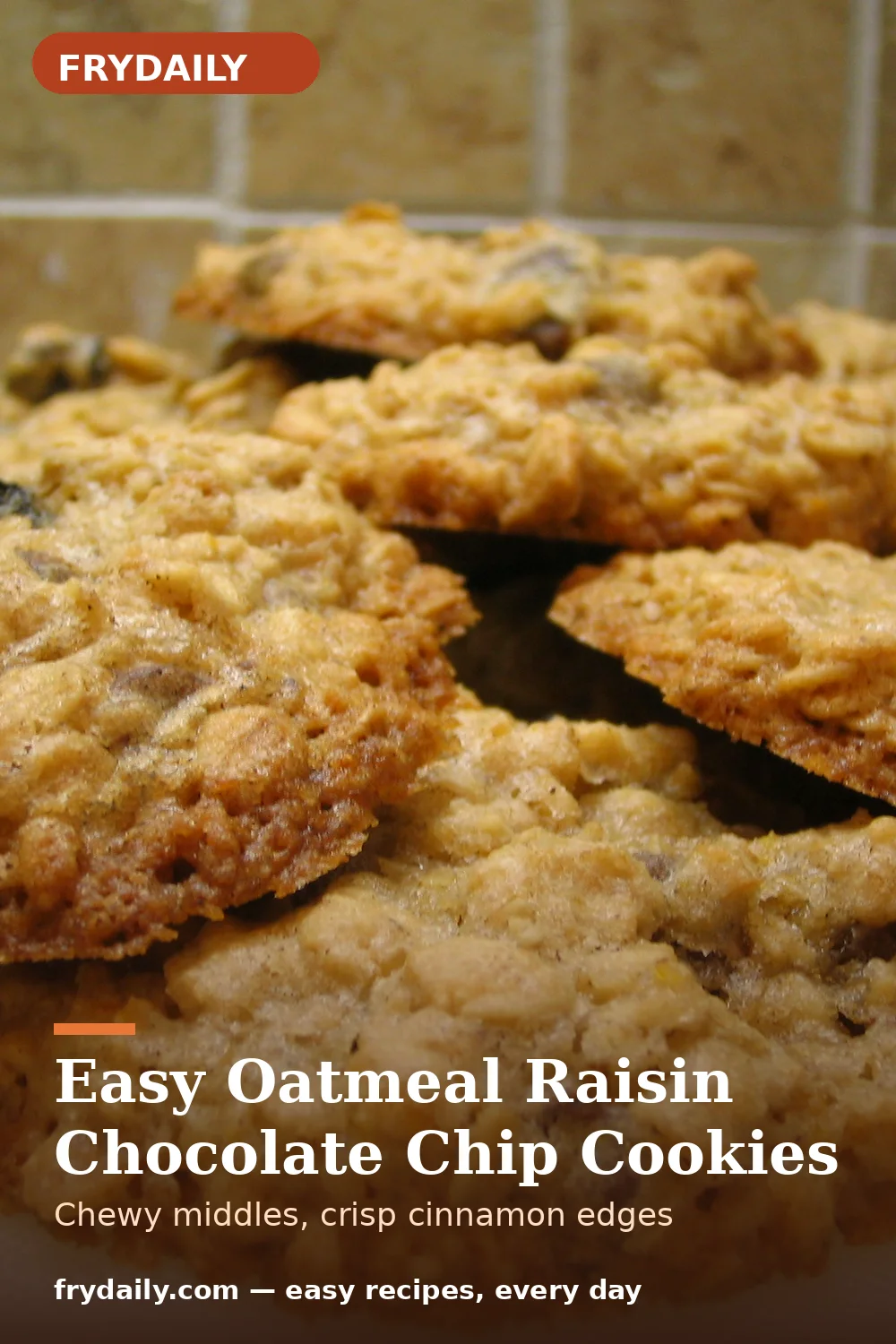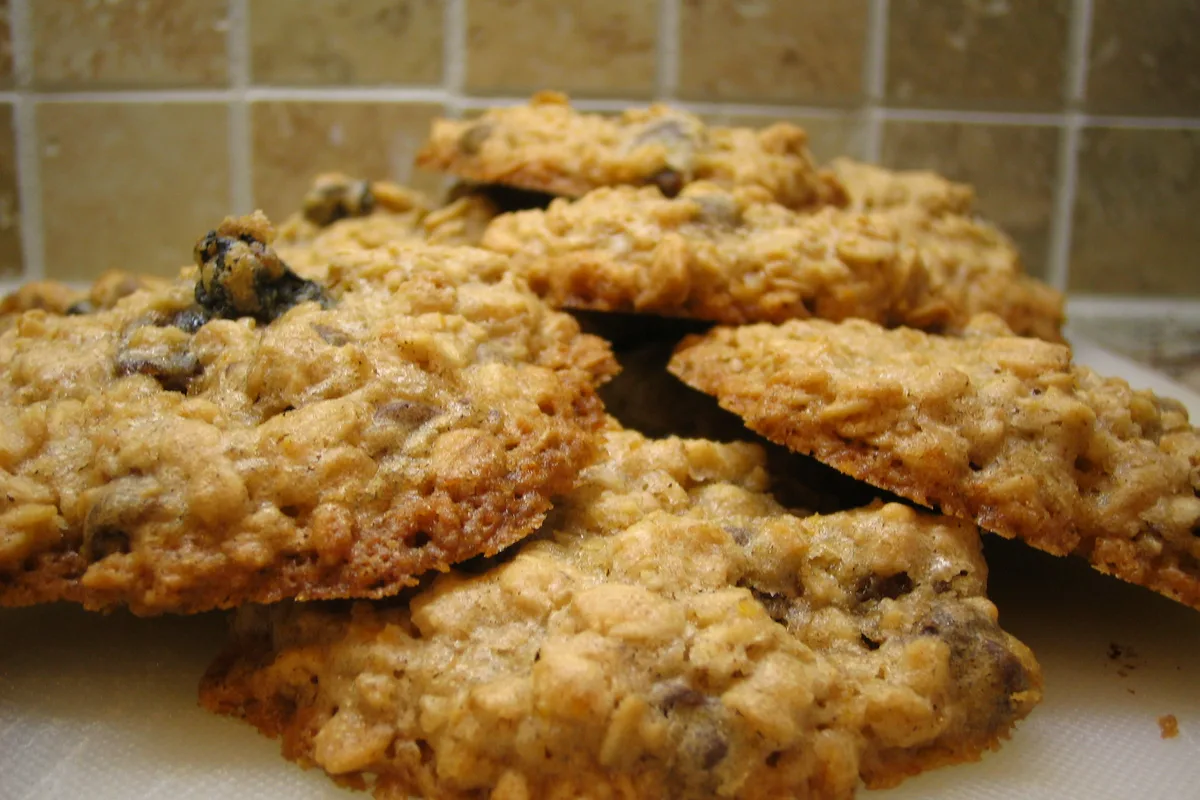
A good oatmeal cookie is a texture argument won on both sides: crisp, lacy edges giving way to a soft, chewy middle, with the oats themselves still distinct — the stack in the photograph shows exactly that, golden and rough-textured, raisins and chocolate chips showing through the crumb. This version loads the dough with both raisins and chips, because choosing between them has never once improved a cookie.
Find it in our Desserts collection with Chocolate Chip Cookies — the two share a dough logic of melted butter and an extra yolk for chew — and it keeps company with Classic Apple Pie on the cinnamon shelf. The quiet ingredient here is a teaspoon of orange zest, borrowed from the combination that makes these cookies taste brighter than the standard bakery version without announcing itself as citrus.
Three habits keep oatmeal cookies chewy instead of cakey or hard. Melted butter, not creamed, gives a denser chew. A short rest lets the oats absorb moisture so the cookies bake up moist rather than raw-tasting in the middle. And pulling the trays when the centres still look slightly underdone — they set as they cool — is the difference between a cookie that bends and one that snaps.
Old-fashioned oats, never instant
Rolled old-fashioned oats are the whole point of the texture: they keep their shape, toast at the edges and give the cookie its characteristic chew. Instant oats dissolve into the dough and make a soft, uniform, slightly gummy cookie; steel-cut oats never soften and stay hard as gravel. If your rolled oats are very thick, a few pulses in a food processor breaks some down and helps the dough hold together — but leave most of them whole, because the visible flakes are what people want to see.
Plump the raisins first
Dry raisins straight from the bag bake into chewy little bullets and steal moisture from the crumb around them. Ten minutes in hot water — or hot orange juice, which echoes the zest — plumps them into soft, jammy pockets. Drain and pat them dry before they go into the dough; wet raisins are just as much of a problem, sliding around and making pale wet spots. The same trick rescues the end of any dried fruit bag: cranberries, cherries and chopped apricots all plump beautifully.
Ingredients
- 3/4 cup unsalted butter, melted (170 g)
- 1 cup packed light brown sugar (200 g)
- 1/2 cup granulated sugar (100 g)
- 1 large egg plus 1 egg yolk, at room temperature (about 70 g total)
- 2 teaspoons vanilla extract (10 ml)
- 1 teaspoon finely grated orange zest (2 g)
- 1 1/2 cups all-purpose flour (180 g)
- 1 teaspoon ground cinnamon (2.6 g)
- 1/2 teaspoon baking soda (2.4 g)
- 3/4 teaspoon fine salt (4.5 g)
- 3 cups old-fashioned rolled oats (270 g)
- 3/4 cup raisins (110 g), plumped and patted dry
- 3/4 cup semisweet chocolate chips (130 g)
Amounts are for the yield below. US customary measures first, grams in brackets for scale users.
Step-by-step instructions
- Whisk the butter and sugars. Whisk the melted butter, both sugars and the salt in a large bowl until glossy and combined, about 30 seconds. Whisk in the egg, the extra yolk, the vanilla and the orange zest until the mixture looks like caramel sauce. Melted butter plus an extra yolk is the chew engine of this recipe — no mixer, no creaming, and no need to soften anything beyond melting the butter. Let the bowl sit for 2 minutes so the sugar starts dissolving; the tops will bake shinier for it.
- Add the dry ingredients and oats. Sprinkle the flour, cinnamon and baking soda over the bowl and stir with a spatula until almost no flour shows. Add the oats, plumped raisins and chocolate chips and fold until everything is evenly distributed and the dough is thick and heavy. It will look like a lot of oats for the dough — that ratio is correct, and it is what makes the baked cookie read as an oatmeal cookie rather than a sugar cookie with oats in it.
- Rest the dough. Rest the dough for 15 minutes at room temperature — set a timer. The oats drink up moisture during the rest, the flour hydrates, and the cookies spread predictably instead of puddling. For deeper flavour and even less spread, cover and refrigerate the dough for up to 24 hours and bake from cold, adding 1 minute. Scoop after resting: use a 2 tablespoon (30 ml) scoop or roll balls of about 40 g each.
- Bake to the edge of done. Heat the oven to 350°F (177°C) and line two trays with parchment. Space the dough balls 2 inches (5 cm) apart and bake one tray at a time for 11 to 13 minutes, until the edges are golden and set but the centres still look pale and slightly soft. That pale centre is the whole game — it finishes setting on the hot tray. Cool on the tray for 10 minutes, then move to a rack. The cookies keep their chew for days if they survive the first evening.
Nutrition estimate
| Nutrient | Per serving |
|---|---|
| Calories | 178 kcal |
| Protein | 2 g |
| Carbohydrates | 27 g |
| Fat | 7 g |
| Saturated fat | 4 g |
| Sodium | 95 mg |
| Fiber | 2 g |
| Sugar | 16 g |
Nutrition figures are estimates calculated from standard ingredient data for the yield stated. Your actual values will vary with brands, substitutions and portion sizes — treat them as a guide, not a guarantee.
Storage & reheating
Baked cookies keep in an airtight container at room temperature for up to 5 days; a slice of sandwich bread in the container keeps them soft. They freeze baked for up to 3 months — thaw at room temperature for 20 minutes, or warm for 8 seconds in the microwave for a just-baked centre. Scooped raw dough balls freeze even better: freeze solid on a tray, bag for up to 3 months, and bake from frozen at 350°F (177°C) for 13 to 15 minutes. Nutrition values are estimates per cookie and vary with your exact chips and oats.
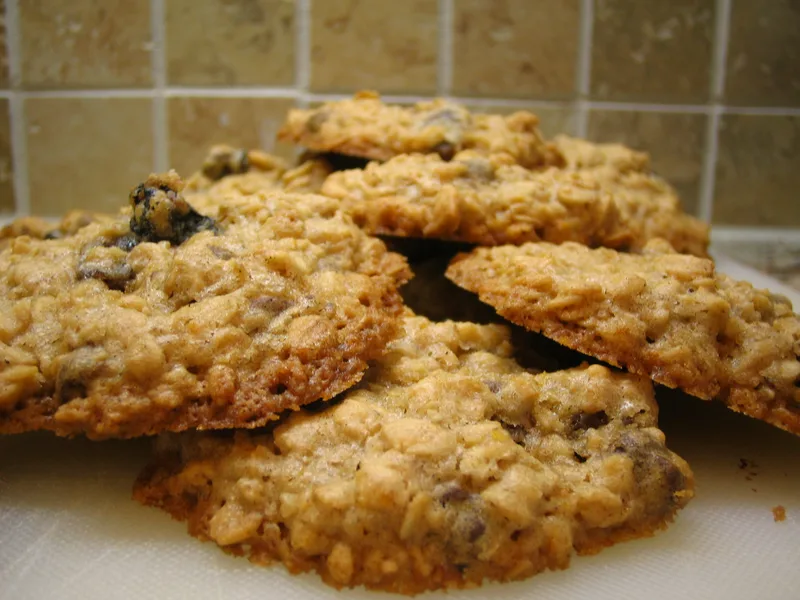
Easy Oatmeal Raisin Chocolate Chip Cookies
Chewy, cinnamon-spiced, studded with raisins and chocolate chips.
Ingredients
Tick ingredients off as you prep, and tap a step below to mark it done as you cook. Scaling adjusts the listed amounts - seasoning to taste stays your call.
Instructions
- Whisk the butter and sugars. Whisk the melted butter, both sugars and the salt in a large bowl until glossy and combined, about 30 seconds. Whisk in the egg, the extra yolk, the vanilla and the orange zest until the mixture looks like caramel sauce. Melted butter plus an extra yolk is the chew engine of this recipe — no mixer, no creaming, and no need to soften anything beyond melting the butter. Let the bowl sit for 2 minutes so the sugar starts dissolving; the tops will bake shinier for it.
- Add the dry ingredients and oats. Sprinkle the flour, cinnamon and baking soda over the bowl and stir with a spatula until almost no flour shows. Add the oats, plumped raisins and chocolate chips and fold until everything is evenly distributed and the dough is thick and heavy. It will look like a lot of oats for the dough — that ratio is correct, and it is what makes the baked cookie read as an oatmeal cookie rather than a sugar cookie with oats in it.
- Rest the dough. Rest the dough for 15 minutes at room temperature — set a timer. The oats drink up moisture during the rest, the flour hydrates, and the cookies spread predictably instead of puddling. For deeper flavour and even less spread, cover and refrigerate the dough for up to 24 hours and bake from cold, adding 1 minute. Scoop after resting: use a 2 tablespoon (30 ml) scoop or roll balls of about 40 g each.
- Bake to the edge of done. Heat the oven to 350°F (177°C) and line two trays with parchment. Space the dough balls 2 inches (5 cm) apart and bake one tray at a time for 11 to 13 minutes, until the edges are golden and set but the centres still look pale and slightly soft. That pale centre is the whole game — it finishes setting on the hot tray. Cool on the tray for 10 minutes, then move to a rack. The cookies keep their chew for days if they survive the first evening.
Recipe by Ahsan ul Haq · FryDaily. Printing? This card is designed to print cleanly on its own.