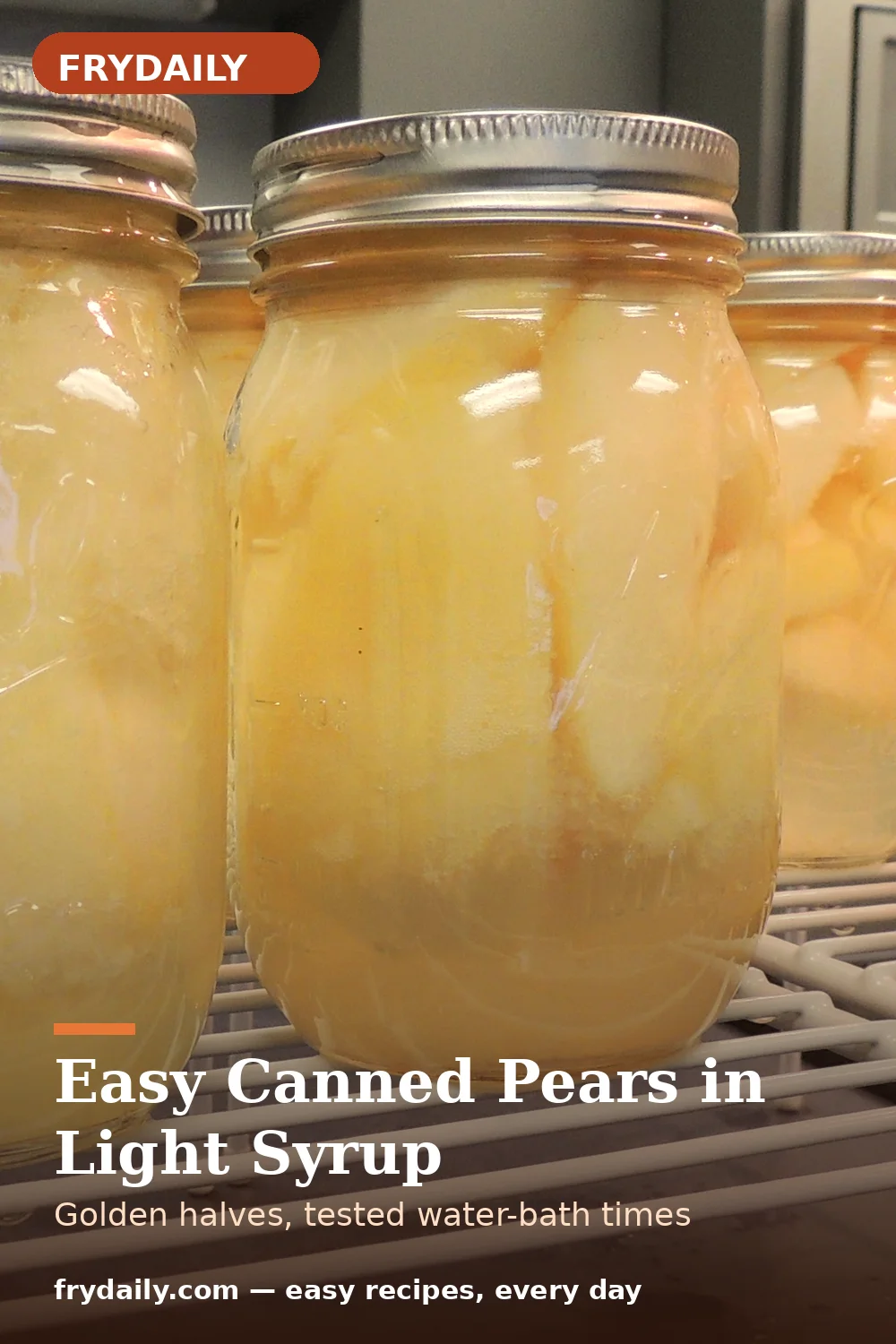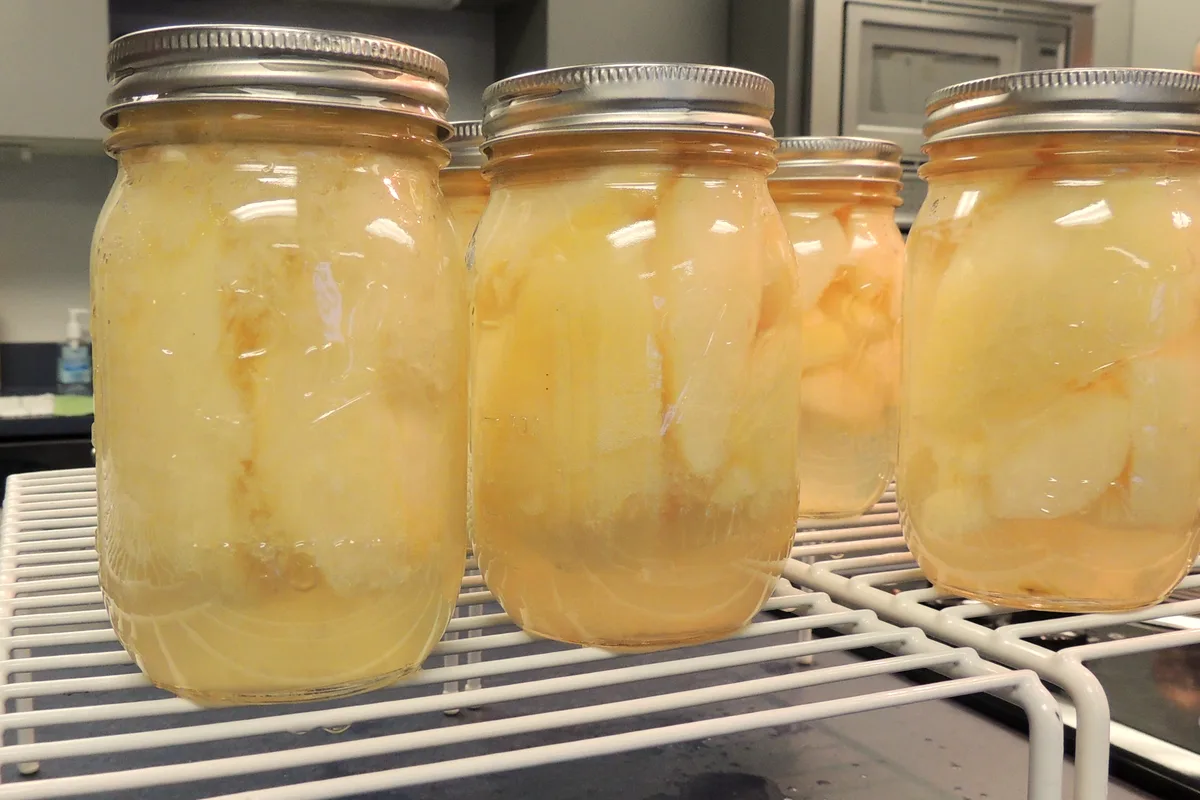
A row of sealed jars of pears, pale gold in light syrup and cooling on a rack like the jars in the photograph, is one of the most useful things a pantry can hold: dessert on a weeknight, a topping for oatmeal, a pie filling that is already sweetened and spiced if you add the spice. Canning pears is also the rescue for the box of Bartletts that all ripen on the same Tuesday, which is how most home canners meet this recipe.
It joins our Canning & Preserving shelf next to Canned Apricots — the same hot-pack, light-syrup method on a different stone fruit — and the syrup logic is shared with Homemade Applesauce. As always on this site, the processing times below are the tested water-bath times for pears from the USDA and National Center for Home Food Preservation guidance — follow them exactly, and do not improvise on time, headspace or acidity when you are sealing jars for the shelf.
Choose pears that are ripe but still firm — a canned pear made from a soft pear is mush, and one made from a hard pear never sweetens properly in the jar. Bartletts are the classic choice and the easiest to find. Work in small batches so the peeled fruit does not wait and brown, keep the prepared pears in lemon water while you work, and hot-pack them: a five-minute simmer in the syrup before the jars are filled is what keeps the fruit from floating and the jars from siphoning.
Tested times, headspace and altitude — the safety core
Pears are a high-acid fruit and are safely processed in a boiling-water canner. For hot-packed pears in syrup, the tested times are 20 minutes for pints and 25 minutes for quarts at elevations up to 1,000 feet (305 m), with 1/2 inch (1.3 cm) headspace. At higher elevations the water boils cooler, so the time must rise: at 1,001 to 3,000 feet use 25 minutes for pints and 30 for quarts; at 3,001 to 6,000 feet use 30 and 35; above 6,000 feet use 35 and 40. Start timing only when the water returns to a full rolling boil with the jars covered by 1 to 2 inches (2.5 to 5 cm) of water.
Syrup strength and keeping the fruit pale
Light syrup — about 2 cups of sugar to 6 cups of water — is the sweet spot for pears: enough to hold their shape and colour and carry flavour, not so much that the fruit tastes candied. Very light syrup and even plain water are tested-safe options too; the fruit will be softer and less rich, and a little more prone to floating. Pears darken on contact with air, so drop every peeled half straight into a bowl of water with 2 tablespoons of lemon juice per gallon, and drain well before the syrup simmer. A cinnamon stick or a split vanilla bean in the syrup pot is optional and lovely, but add spices to the pot, not loose into each jar, so the flavour stays even.
Ingredients
- 5 lb ripe but firm Bartlett pears (2.3 kg)
- 6 cups water (1.4 litres), for the syrup
- 2 cups granulated sugar (400 g), for light syrup
- 2 tablespoons lemon juice (30 ml), for the holding water
- 1 gallon cold water (3.8 litres), for holding the pears
- 1 cinnamon stick (3 g), optional
- 1 teaspoon vanilla extract (5 ml), optional
Amounts are for the yield below. US customary measures first, grams in brackets for scale users.
Step-by-step instructions
- Prepare the canner, jars and syrup. Fill a boiling-water canner halfway, set 4 clean pint jars in it, and bring to a simmer at 180°F (82°C). Stir the 6 cups of water and the sugar in a large pot and heat, stirring, until the sugar dissolves; keep the light syrup at a bare simmer, with the cinnamon stick if using. Stir the lemon juice into the gallon of cold water in a large bowl for holding the peeled pears.
- Peel, halve and hold the pears. Wash the pears, peel them, halve them lengthwise, and cut out the cores and stems with a small spoon or paring knife. Drop each finished half straight into the lemon water so it does not brown. Work steadily in one direction — peel all, then core all — so no batch of fruit waits exposed. Pears that are ripe but firm will hold their shape through processing; very soft fruit should be set aside for eating fresh.
- Hot-pack: simmer, fill, remove bubbles. Drain the pear halves, add them to the simmering syrup, and cook gently for 5 minutes — this hot pack drives out air, keeps the fruit from floating, and warms it through. Pack the hot halves, cavity side down, into the hot jars, and cover with hot syrup, leaving 1/2 inch (1.3 cm) headspace. Slide a bubble remover or chopstick around the inside of each jar, re-check the headspace, wipe the rims clean, and apply lids and bands fingertip-tight.
- Process, cool and check the seals. Lower the jars into the canner, ensure they are covered by 1 to 2 inches (2.5 to 5 cm) of water, cover, and bring to a full rolling boil. Process pints for 20 minutes at elevations up to 1,000 feet (305 m), adjusting upward for altitude as described above. When the time ends, turn off the heat, wait 5 minutes, then lift the jars to a towel-lined rack — like the cooling jars in the photograph — and leave them undisturbed for 12 to 24 hours. Check that every lid is sealed and concave before labelling and storing.
Nutrition estimate
| Nutrient | Per serving |
|---|---|
| Calories | 120 kcal |
| Protein | 1 g |
| Carbohydrates | 31 g |
| Fat | 0 g |
| Saturated fat | 0 g |
| Sodium | 0 mg |
| Fiber | 3 g |
| Sugar | 26 g |
Nutrition figures are estimates calculated from standard ingredient data for the yield stated. Your actual values will vary with brands, substitutions and portion sizes — treat them as a guide, not a guarantee.
Storage & reheating
Sealed jars keep in a cool, dark cupboard for up to 12 months at best quality. Refrigerate any jar that does not seal and use it within 1 week. Once opened, refrigerate and use within 1 week. Always check seals before use and discard any jar with a bulging lid, spurting liquid, off smell or mould — when in doubt, throw it out. The servings and nutrition here are per half-pint (about 120 g) of pears in light syrup, drained.
Canning safety — read first
Home canning must follow tested processes exactly. The times on this page follow the structure of current USDA guidance for the stated jar size at 0-1,000 feet elevation; always confirm processing times and altitude adjustments in the USDA Complete Guide to Home Canning or the National Center for Home Food Preservation before you start. Never taste food from a jar with a failed seal, bulging lid or off odor — discard it.
Easy Canned Pears in Light Syrup
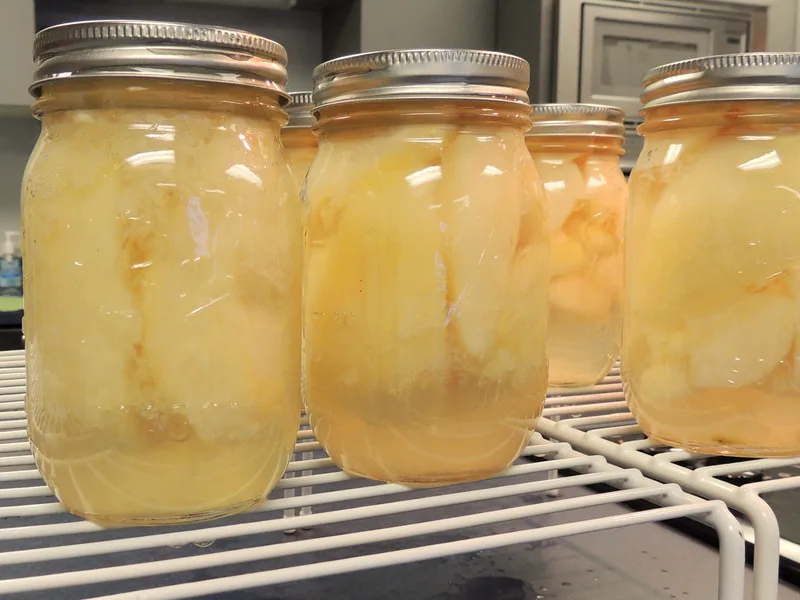
Golden pear halves in light syrup, hot-packed and water-bath processed — tested times, pantry-ready jars.
Ingredients
Tick ingredients off as you prep, and tap a step below to mark it done as you cook. Scaling adjusts the listed amounts - seasoning to taste stays your call.
Instructions
- Prepare the canner, jars and syrup. Fill a boiling-water canner halfway, set 4 clean pint jars in it, and bring to a simmer at 180°F (82°C). Stir the 6 cups of water and the sugar in a large pot and heat, stirring, until the sugar dissolves; keep the light syrup at a bare simmer, with the cinnamon stick if using. Stir the lemon juice into the gallon of cold water in a large bowl for holding the peeled pears.
- Peel, halve and hold the pears. Wash the pears, peel them, halve them lengthwise, and cut out the cores and stems with a small spoon or paring knife. Drop each finished half straight into the lemon water so it does not brown. Work steadily in one direction — peel all, then core all — so no batch of fruit waits exposed. Pears that are ripe but firm will hold their shape through processing; very soft fruit should be set aside for eating fresh.
- Hot-pack: simmer, fill, remove bubbles. Drain the pear halves, add them to the simmering syrup, and cook gently for 5 minutes — this hot pack drives out air, keeps the fruit from floating, and warms it through. Pack the hot halves, cavity side down, into the hot jars, and cover with hot syrup, leaving 1/2 inch (1.3 cm) headspace. Slide a bubble remover or chopstick around the inside of each jar, re-check the headspace, wipe the rims clean, and apply lids and bands fingertip-tight.
- Process, cool and check the seals. Lower the jars into the canner, ensure they are covered by 1 to 2 inches (2.5 to 5 cm) of water, cover, and bring to a full rolling boil. Process pints for 20 minutes at elevations up to 1,000 feet (305 m), adjusting upward for altitude as described above. When the time ends, turn off the heat, wait 5 minutes, then lift the jars to a towel-lined rack — like the cooling jars in the photograph — and leave them undisturbed for 12 to 24 hours. Check that every lid is sealed and concave before labelling and storing.
Recipe by Ahsan ul Haq · FryDaily. Printing? This card is designed to print cleanly on its own.