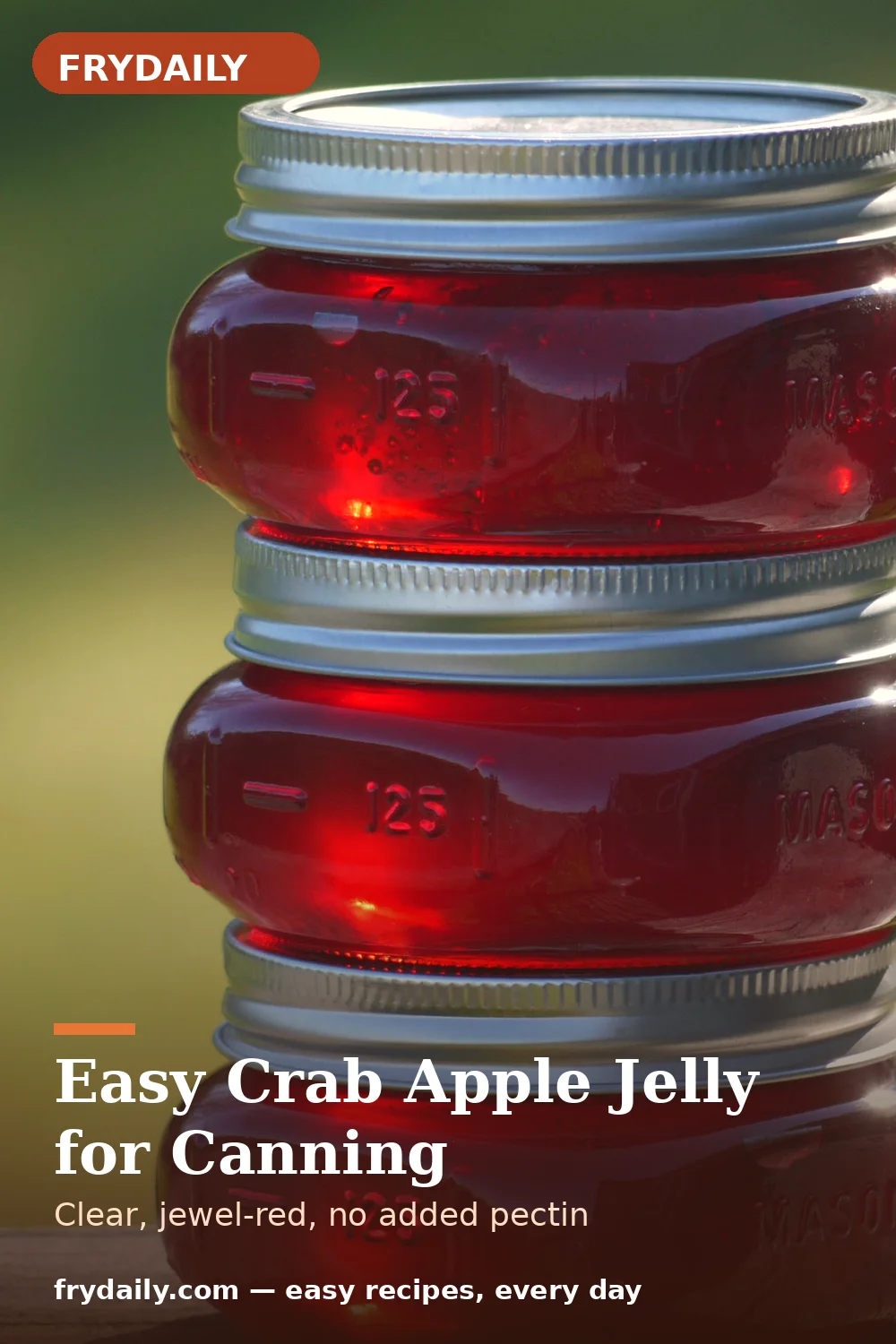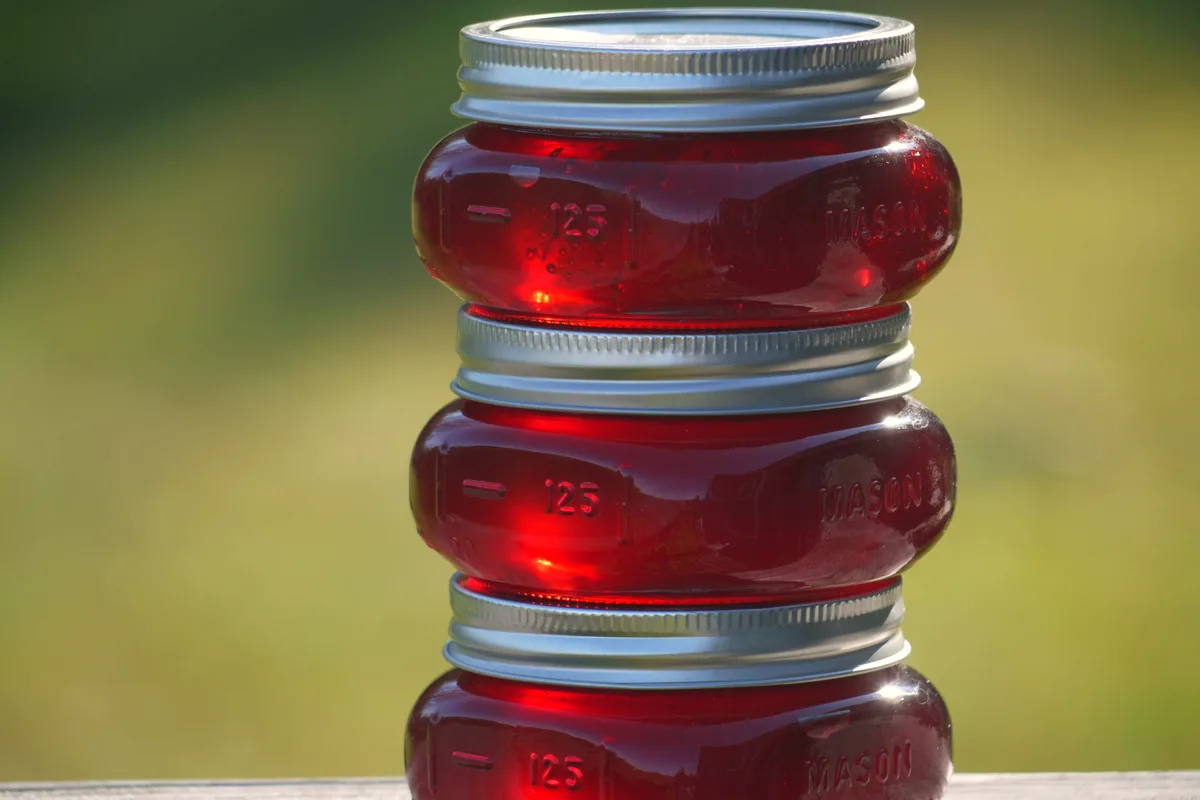
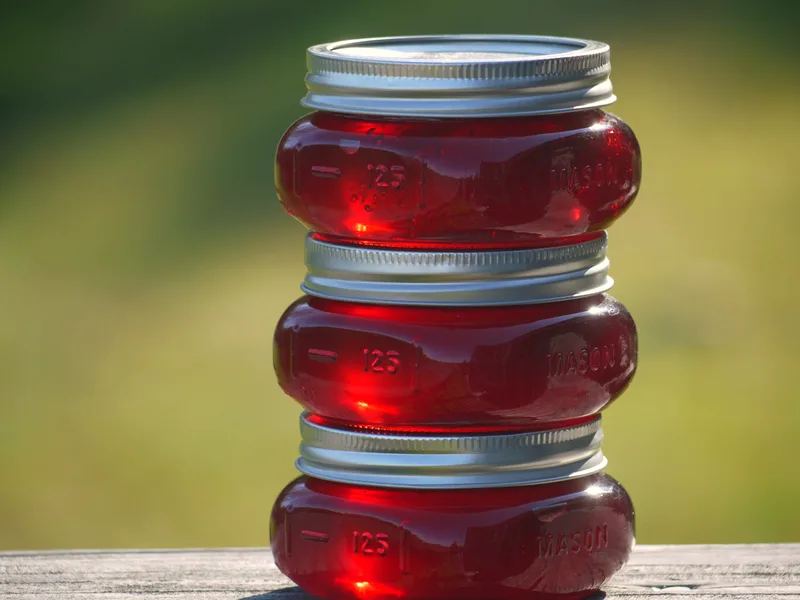
Crab apple jelly is the preserve that makes itself: the fruit is so rich in natural pectin that no boxed pectin is needed, and the juice cooks into the clear, jewel-red jelly in the photograph — jars that glow when the light goes through them. If you have a crab apple tree, or a neighbour who does and wishes someone would take the fruit, this is the recipe that turns a bucket of tart little apples into a year of toast, glazes and gifts.
It joins our Canning & Preserving shelf next to Grape Jelly — the same strain, sweeten and water-bath method — and the jam-makers who liked Blueberry Jam will find the jelly set test here works exactly the same way. As always on this site, the processing time, headspace and method below follow USDA and National Center for Home Food Preservation guidance — follow them exactly and do not improvise when sealing jars for the shelf.
The one real skill is restraint at the straining stage. The juice must drip through the jelly bag on its own, over hours, without squeezing — squeeze and the jelly turns cloudy, however well it sets. Clear juice in, clear jelly out: the jars in the photograph are the reward for patience the night before.
No added pectin — and why it works
Crab apples are among the most pectin-rich fruits there are, especially when a share of the batch is just underripe, and their juice gels with sugar and acid alone. That is also why the recipe gives a set test rather than a fixed boiling time: pectin varies with the fruit, so you cook the juice to the sheeting stage — when the jelly falls from a cold spoon in a sheet rather than drops — or to 220°F (104°C) on a thermometer at sea level. A chilled saucer kept in the freezer gives the backup test: a spoonful set on it for a minute should wrinkle when pushed.
Tested times, headspace and altitude — the safety core
This jelly is a high-acid food and is safely processed in a boiling-water canner. Fill hot half-pint jars leaving 1/4 inch (0.6 cm) of headspace, wipe the rims, apply lids and bands fingertip-tight, and process for 10 minutes at elevations up to 1,000 feet (305 m), adjusting upward for altitude per current USDA guidance. Start timing only when the water returns to a full rolling boil with the jars covered by 1 to 2 inches (2.5 to 5 cm) of water. Rest the jars in the canner for 5 minutes after the heat goes off, then cool undisturbed for 12 to 24 hours and check every seal before labelling.
Ingredients
- 4 lb crab apples (1.8 kg), washed, stems removed, blossom ends trimmed
- 4 cups water (950 ml), to cover the fruit
- 4 cups crab apple juice (950 ml), strained overnight, from the cooked fruit
- 3 cups granulated sugar (600 g)
- 2 tablespoons lemon juice (30 ml)
Amounts are for the yield below. US customary measures first, grams in brackets for scale users.
Step-by-step instructions
- Cook the fruit for juice. Halve the crab apples — no need to peel or core, the pectin lives in the skins and cores — and put them in a large pot with the water. Simmer, covered, for 25 to 30 minutes, mashing once or twice, until the fruit is completely soft and collapsing. Do not let it boil dry; add a splash more water if the pot looks bare.
- Strain overnight without squeezing. Ladle the hot fruit into a jelly bag or a colander lined with damp muslin set over a deep bowl. Let the juice drip for at least 4 hours, ideally overnight in the refrigerator. Never squeeze or press the bag: the clearest juice drips freely, and pressed juice makes cloudy jelly no matter how carefully you cook it.
- Boil the jelly to the set point. Measure 4 cups (950 ml) of juice into a wide, deep pan with the lemon juice and sugar. Stir over medium heat until the sugar dissolves, then boil rapidly, skimming any foam, until the jelly reaches 220°F (104°C) or sheets from a cold spoon — about 10 to 14 minutes of hard boiling. Test on the chilled saucer: a set sample wrinkles when pushed.
- Fill the hot jars. Work quickly while the jelly is hot. Ladle it into hot, clean half-pint jars, leaving 1/4 inch (0.6 cm) of headspace. Run a clean utensil around the inside to release air bubbles, wipe the rims with a damp cloth, and apply the lids and bands fingertip-tight — snug, never forced.
- Process, cool and check the seals. Lower the jars into the boiling-water canner, covered by 1 to 2 inches (2.5 to 5 cm) of water, and process half-pints for 10 minutes at elevations up to 1,000 feet (305 m), adjusting for altitude per USDA guidance. Rest 5 minutes in the canner, then lift the jars to a towel and cool undisturbed for 12 to 24 hours. Lids should be concave and sealed before the jars are labelled and stored.
Nutrition estimate
| Nutrient | Per serving |
|---|---|
| Calories | 56 kcal |
| Protein | 0 g |
| Carbohydrates | 14 g |
| Fat | 0 g |
| Saturated fat | 0 g |
| Sodium | 1 mg |
| Fiber | 0 g |
| Sugar | 14 g |
Nutrition figures are estimates calculated from standard ingredient data for the yield stated. Your actual values will vary with brands, substitutions and portion sizes — treat them as a guide, not a guarantee.
Storage & reheating
Sealed jars keep in a cool, dark pantry for up to 12 months; the colour is best inside the first 6. Once a jar is opened, refrigerate it and use within 1 month. Any jar that fails to seal should be refrigerated and used within a few weeks, or reprocessed within 24 hours with a new lid and the full processing time. Jelly that is a little soft still makes an excellent glaze for roast pork and ham.
Canning safety — read first
Home canning must follow tested processes exactly. The times on this page follow the structure of current USDA guidance for the stated jar size at 0-1,000 feet elevation; always confirm processing times and altitude adjustments in the USDA Complete Guide to Home Canning or the National Center for Home Food Preservation before you start. Never taste food from a jar with a failed seal, bulging lid or off odor — discard it.
Easy Crab Apple Jelly for Canning
Clear, jewel-red crab apple jelly — no added pectin, tested water-bath method.
Ingredients
Tick ingredients off as you prep, and tap a step below to mark it done as you cook. Scaling adjusts the listed amounts - seasoning to taste stays your call.
Instructions
- Cook the fruit for juice. Halve the crab apples — no need to peel or core, the pectin lives in the skins and cores — and put them in a large pot with the water. Simmer, covered, for 25 to 30 minutes, mashing once or twice, until the fruit is completely soft and collapsing. Do not let it boil dry; add a splash more water if the pot looks bare.
- Strain overnight without squeezing. Ladle the hot fruit into a jelly bag or a colander lined with damp muslin set over a deep bowl. Let the juice drip for at least 4 hours, ideally overnight in the refrigerator. Never squeeze or press the bag: the clearest juice drips freely, and pressed juice makes cloudy jelly no matter how carefully you cook it.
- Boil the jelly to the set point. Measure 4 cups (950 ml) of juice into a wide, deep pan with the lemon juice and sugar. Stir over medium heat until the sugar dissolves, then boil rapidly, skimming any foam, until the jelly reaches 220°F (104°C) or sheets from a cold spoon — about 10 to 14 minutes of hard boiling. Test on the chilled saucer: a set sample wrinkles when pushed.
- Fill the hot jars. Work quickly while the jelly is hot. Ladle it into hot, clean half-pint jars, leaving 1/4 inch (0.6 cm) of headspace. Run a clean utensil around the inside to release air bubbles, wipe the rims with a damp cloth, and apply the lids and bands fingertip-tight — snug, never forced.
- Process, cool and check the seals. Lower the jars into the boiling-water canner, covered by 1 to 2 inches (2.5 to 5 cm) of water, and process half-pints for 10 minutes at elevations up to 1,000 feet (305 m), adjusting for altitude per USDA guidance. Rest 5 minutes in the canner, then lift the jars to a towel and cool undisturbed for 12 to 24 hours. Lids should be concave and sealed before the jars are labelled and stored.
Recipe by Ahsan ul Haq · FryDaily. Printing? This card is designed to print cleanly on its own.